Advertisements
Advertisements
प्रश्न
A spring is kept compressed by a small trolley of mass 0.5 kg lying on a smooth horizontal surface as shown in the adjacent fig. When the trolley is released, it is found to move at a speed v = 2 m s-1. What potential energy did the spring possess when compressed?
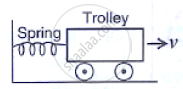
A spring is kept compressed by a toy car of mass 500 g lying on a smooth horizontal ground. On releasing the pressure, the car moves out with a speed of 2 m/s. Determine the potential energy of the compressed spring.
Advertisements
उत्तर
Mass of trolley = 500 g = `500/1000` kg = 0.5 kg
Velocity = 2 m/s
When the compressed spring is released, its potential energy is converted into kinetic energy completely.
Potential energy of compressed spring = kinetic energy of moving trolley
Kinetic energy of trolley = `1/2 × "mass" × ("velocity")^2`
= `1/2 × 0.5 × (2)^2`
= `1/2 × 0.5 × 2 × 2`
= 1 J
Hence, the potential energy of the compressed spring is 1.0 J.
संबंधित प्रश्न
A mass of 10 kg is at a point A on a table. It is moved to a point B. If the line joining A and B is horizontal, what is the work done on the object by the gravitational force? Explain your answer.
Two bodies A and B of masses 10 kg and 20 kg respectively are at the same height above the ground. Which of the two has greater potential energy?
A body of mass m is moved from ground to a height h. If the force of gravity on mass of 1 kg is g newton, find the force needed to lift the body.
A body of mass m is moved from ground to a height h. If force of gravity on mass of 1 kg is g newton, find the work done in lifting the body.
Two bodies A and B of equal masses are kept at heights of h and 2h respectively. What will be the ratio of their potential energies?
A weightlifter is lifting weights of mass 200 kg up to a height of 2 metres. If g = 9.8 m s−2, calculate :
work done by the weightlifter
On what factors does the gravitational potential energy of a body depend?
What is the difference between gravitational potential energy and elastic potential energy? Give one example of a body having gravitational potential energy and another having elastic potential energy.
The energy, possessed by an object due to its position is called ______.
Which of the following is the example potential energy?
