Advertisements
Advertisements
Question
A ball of mass 0.5 kg slows down from a speed of 5 m/s so that of 3 m/s. Calculate the change in kinetic energy of the ball. State your answer giving proper units.
Advertisements
Solution
Mass of the ball, (m) = 0.5 kg
Initial velocity, (v1) = 5 m/s
Final velocity, (v2) = 3 m/s
So, initial kinetic energy can be calculated as,
`K.E = 1/2 mv^2`
Therefore, initial kinetic energy,
`(K.E)_1 = 1/2 xx 0.5 xx 5^2` J
= 6.25 J
Similarly, final kinetic energy,
`(K.E)_2 = 1/2 xx 0.5 xx 3^2` J
= 2.25 J
So, Work done = Change in kinetic energy
Therefore work done,
Work done = (KE)2 – (KE)1
= (2.25 – 6.25) J
= – 4 J
A negative sign shows that the force applied is opposite to the direction of motion of the body.
APPEARS IN
RELATED QUESTIONS
A body falls freely under gravity from rest. Name the kind of energy it will possess while falling.
A pendulum is oscillating on either side of its rest position. The correct statement is:
Is energy a vector quantity?
What kind of energy is possessed by the following?
A stretched rubber band _____________
What type of energy is possessed : by the piece of stone which is thrown away on releasing the stretched rubber strings of catapult?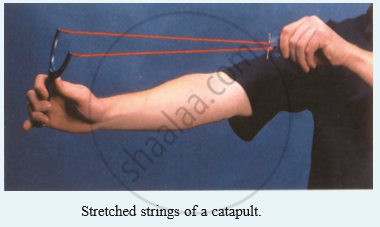
What type of energy is possessed : by the stretched rubber strings of a catapult?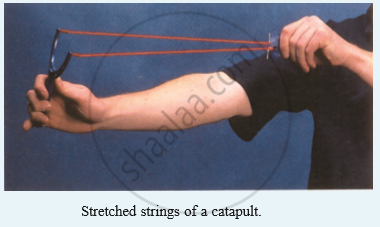
Name the device or machine which convert :
light energy into heat energy.
Fill in the blank with suitable word:
The electricity meter installed in our homes measure electrical energy in the units of ___________.
What kind of energy transformations take place at a coal-based thermal power station?
Which of the following energy change involves frictional force?
