Advertisements
Advertisements
Question
Show that the sum of kinetic energy and potential energy (i.e., total mechanical energy) is always conserved in the case of a freely falling body under gravity (with air resistance neglected) from a height h by finding it when
- The body is at the top.
- the body has fallen a distance x.
- the body has reached the ground.
Advertisements
Solution
The law of conservation of energy:
Energy can neither be created nor destroyed. Verification of the energy conservation law in the event of a body falling.
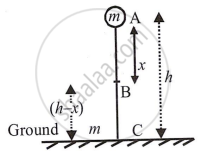
Consider a body of mass (m) raised above the ground to position A at a height (h).
(i) At A
P.E. = mgh
K.E. = 0 ...[∵ body is at rest]
∴ P.E. + K.E. = mgh + 0 = mgh ...(i)
Let it fall from A to B through a distance (x)
In doing so v2 - u2 = 2gx
v2 - 0 = 2gx ...[∴ u at A = 0]
Body is still at height (h - x) above ground.
(ii) At B, P.E. = mg (h - x)
K.E. = `1/2 mv^2`
= `1/2 m (2gx)`
= mgx
∴ P.E. + K.E. = mg (h - x) + mgx
= mgh - mgx + mgx
P.E. + K.E. = mgh
When a body falls on ground, the velocity with which it falls v2 - u2 = 2gh
v2 = 2gh
(iii) At C the ground
P.E. = 0 ...[∵ h = 0]
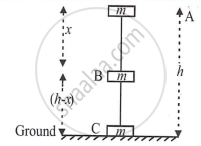
K.E. = `1/2 xx mv^2`
= `1/2 m (2gh)`
= mgh
P.E. + K.E. = 0 + mgh = mgh ...(iii)
This we find in all three cases (i), (ii) and (iii)
The sum total of P.E. + K.E. = mgh which remains constant and hence verifies the law.
APPEARS IN
RELATED QUESTIONS
Does the transfer of energy take place when you push a huge rock with all your might and fail to move it? Where is the energy you spend going?
A ball is placed on a compressed spring. What form of energy does the spring possess? On releasing the spring, the ball flies away. Give a reason.
A metal ball of mass 2 kg is allowed to fall freely from rest from a height of 5 m above the ground. Taking g = 10 m s−2, calculate:
- the potential energy possessed by the ball when it is initially at rest.
- the kinetic energy of the ball just before it hits the ground?
State whether the object possess kinetic energy, potential energy, or both :
A bird running on the ground ____________.
State whether the object possess kinetic energy, potential energy, or both :
A ceiling fan in the off position ______________
What type of energy is possessed : by the stretched rubber strings of a catapult?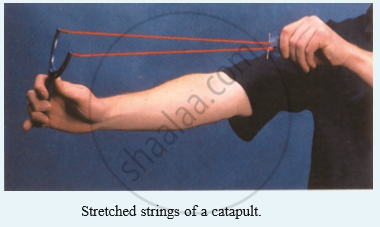
What kind of energy transformation take place at a hydroelectric power station?
How much electrical energy in joules does a 100 watt lamp consume : in 1 minute?
When an object falls freely towards the earth, then its total energy :
An automobile engine propels a 1000 kg car (A) along a levelled road at a speed of 36 km h–1. Find the power if the opposing frictional force is 100 N. Now, suppose after travelling a distance of 200 m, this car collides with another stationary car (B) of the same mass and comes to rest. Let its engine also stop at the same time. Now the car (B) starts moving on the same level road without getting its engine started. Find the speed of the car (B) just after the collision.
