Advertisements
Advertisements
प्रश्न
Show that the sum of kinetic energy and potential energy (i.e., total mechanical energy) is always conserved in the case of a freely falling body under gravity (with air resistance neglected) from a height h by finding it when
- The body is at the top.
- the body has fallen a distance x.
- the body has reached the ground.
Advertisements
उत्तर
The law of conservation of energy:
Energy can neither be created nor destroyed. Verification of the energy conservation law in the event of a body falling.
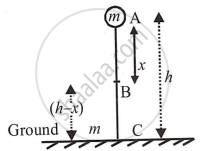
Consider a body of mass (m) raised above the ground to position A at a height (h).
(i) At A
P.E. = mgh
K.E. = 0 ...[∵ body is at rest]
∴ P.E. + K.E. = mgh + 0 = mgh ...(i)
Let it fall from A to B through a distance (x)
In doing so v2 - u2 = 2gx
v2 - 0 = 2gx ...[∴ u at A = 0]
Body is still at height (h - x) above ground.
(ii) At B, P.E. = mg (h - x)
K.E. = `1/2 mv^2`
= `1/2 m (2gx)`
= mgx
∴ P.E. + K.E. = mg (h - x) + mgx
= mgh - mgx + mgx
P.E. + K.E. = mgh
When a body falls on ground, the velocity with which it falls v2 - u2 = 2gh
v2 = 2gh
(iii) At C the ground
P.E. = 0 ...[∵ h = 0]
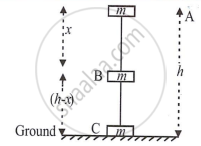
K.E. = `1/2 xx mv^2`
= `1/2 m (2gh)`
= mgh
P.E. + K.E. = 0 + mgh = mgh ...(iii)
This we find in all three cases (i), (ii) and (iii)
The sum total of P.E. + K.E. = mgh which remains constant and hence verifies the law.
APPEARS IN
संबंधित प्रश्न
A metal ball of mass 2 kg is allowed to fall freely from rest from a height of 5 m above the ground. Taking g = 10 m s−2, calculate:
- the potential energy possessed by the ball when it is initially at rest.
- the kinetic energy of the ball just before it hits the ground?
State whether the object possess kinetic energy, potential energy, or both :
A flying aeroplane _______________.
What kind of energy is possessed by the following?
A stone kept on roof-top _______________
What kind of energy is possessed by the following?
A running car ____________
Two bodies having equal masses are moving with uniform speeds of v and 2v respectively. Find the ratio of their kinetic energies.
Name the device or machine which convert :
Electrical energy into heat energy.
Fill in the blanks with suitable words:
When a ball is thrown upwards, ___________ energy is transformed into ___________ energy.
A ball falls to the ground as shown below :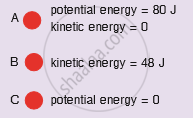
What is the kinetic energy of ball when it hits the ground?
How much energy does a 100 W electric bulb transfer in 1 minute?
A microphone converts :
