Advertisements
Advertisements
प्रश्न
A stone is thrown upwards as shown in the diagram. When it reaches P, which of the following has the greatest value of the stone?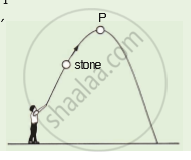
पर्याय
its acceleration
its kinetic energy
its potential energy
its weight
Advertisements
उत्तर
When a stone is thrown vertically upwards, the following conclusions can be done for point P,
(a) The acceleration for the entire journey of the stone is constant, as acceleration due to gravity near the surface of the earth is constant.
(b) The velocity of the stone at P will be the least. Hence, kinetic energy at this point will be the least.
(c) The stone is at a maximum height at point P. Hence, the potential energy is the maximum at P.
(d) Weight of the stone will remain nearly constant, as acceleration due to gravity near the surface of the earth is constant.
Therefore, the answer is: (c) Its potential energy.
APPEARS IN
संबंधित प्रश्न
Is energy a vector quantity?
What kind of energy is possessed by the following?
Water stored in the reservoir of a dam __________.
Two bodies having equal masses are moving with uniform speeds of v and 2v respectively. Find the ratio of their kinetic energies.
Water stored in a dam possesses ______.
Name the device or machine which convert :
Electrical energy into heat energy.
Name the device or machine which convert :
Chemical energy into heat energy.
What kind of energy transformations take place at a coal-based thermal power station?
What do you understand by the term 'transformation of energy"? Explain with an example.
Explain the transformation of energy in the following cases :
(i) A ball thrown upwards.
(ii) A stone dropped from the roof of a building.
Name the energy transfers which occur when a torch is on.
