Advertisements
Advertisements
प्रश्न
A metal ball of mass 2 kg is allowed to fall freely from rest from a height of 5 m above the ground. Taking g = 10 m s−2, calculate:
- the potential energy possessed by the ball when it is initially at rest.
- the kinetic energy of the ball just before it hits the ground?
Advertisements
उत्तर
Mass of the ball m = 2 kg, g = 10 ms−2, h = 5 m
(i) Potential Energy possessed by the ball = mgh
= 2 × 10 × 5
= 100 J
(ii) K.E of ball = potential Energy = 100 J
or v2 = 2gh
v2 = 2 × 10 × 5
= 100 J
∴ K.E = `1/2 mv^2`
= `1/2 xx 2 xx 100`
= 100 J
APPEARS IN
संबंधित प्रश्न
In what way does the temperature of water at the bottom of a waterfall differ from the temperature at the top? Explain the reason.
State whether the object possess kinetic energy, potential energy, or both :
A bird running on the ground ____________.
What are the various forms of energy?
Water stored in a dam possesses ______.
A stone is thrown upwards as shown in the diagram. When it reaches P, which of the following has the greatest value of the stone?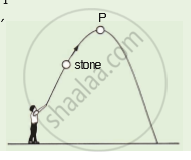
Five electric fans of 120 watts each are used for 4 hours. Calculate the electrical energy consumed in kilowatt-hours.
Name the energy transfers which occur when an electric ball rings.
Name the energy transfers which occur when a torch is on.
A microphone converts :
A body of mass 10 kg at rest is acted upon simultaneously by two forces 4 N and 3 N at right angles to each other. The kinetic energy of the body at the end of 10 s is
