Advertisements
Advertisements
प्रश्न
A metal ball of mass 2 kg is allowed to fall freely from rest from a height of 5 m above the ground. Taking g = 10 m s−2, calculate:
- the potential energy possessed by the ball when it is initially at rest.
- the kinetic energy of the ball just before it hits the ground?
Advertisements
उत्तर
Mass of the ball m = 2 kg, g = 10 ms−2, h = 5 m
(i) Potential Energy possessed by the ball = mgh
= 2 × 10 × 5
= 100 J
(ii) K.E of ball = potential Energy = 100 J
or v2 = 2gh
v2 = 2 × 10 × 5
= 100 J
∴ K.E = `1/2 mv^2`
= `1/2 xx 2 xx 100`
= 100 J
APPEARS IN
संबंधित प्रश्न
A body falls freely under gravity from rest. Name the kind of energy it will possess while falling.
State whether the object possess kinetic energy, potential energy, or both :
A bird running on the ground ____________.
A boy weighing 40 kg makes a high jump of 1.5 m.
What is his kinetic energy at the highest point?
Name the device which converts electrical energy into mechanical energy.
Name the device or machine which convert :
Chemical energy into electrical energy.
Fill in the blanks with suitable words:
When a ball is thrown upwards, ___________ energy is transformed into ___________ energy.
What do you understand by the term 'transformation of energy"? Explain with an example.
A ball falls to the ground as shown below :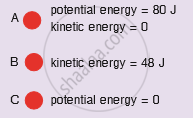
What is the kinetic energy of ball when it hits the ground?
How much energy does a 100 W electric bulb transfer in 1 minute?
A microphone converts :
