Advertisements
Advertisements
प्रश्न
A stone of mass 500 g is thrown vertically upwards with a velocity of 15 m/s. Calculate:
- the potential energy at the greatest height,
- the kinetic energy on reaching the ground, and
- the total energy at its half-way point.
Advertisements
उत्तर
(a) Mass of stone m = 500 g = `500/1000 = 1/2 kg`
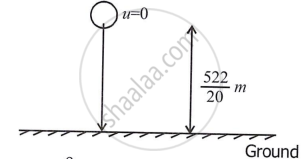
v = 0
u = 15 m/s
∴ v2 - u2 = 2gh
0 – 15 × 15 = 2gh
∴ gh = `(-225)/2`
10 h = `(-225)/2 or h = (-225)/(20) m`
A negative sign shows the stone is moving upward.
∴ Potential Energy = mgh
= `1/2 xx 10 xx 225/20`
= 56.25 J
(b) On the way back
u = 0, h = `225/20 m`, v = ?
v2 - u2 = 2gh
∴ v2 - 0 = `2 × 10 × 225/20`
∴ v2 - 0 = 225
∴ v = `sqrt225`
∴ v = 15 ms-1
K.E on reaching ground = `1/2 mv^2`
= `1/2 xx 1/2 xx 15 xx 15`
= 56.25 J
(c) Total energy at halfway point = mgh
= `1/2 xx 10 xx 225/20`
= 56.25 J
APPEARS IN
संबंधित प्रश्न
State whether the object possess kinetic energy, potential energy, or both :
A flying aeroplane _______________.
An iron sphere of mass 10 kg has the same diameter as an aluminium sphere of mass 3.5 kg. Both the spheres are dropped simultaneously from a tower. When they are 10 m above the ground, they have the same :
Name the device or machine which convert :
Electrical energy into light energy.
Name the device or machine which convert :
Heat energy into kinetic energy (or mechanical energy).
Fill in the blanks with suitable words :
The principle of ___________ of energy says energy can be transformed from one form to another, but it cannot be ___________ or ___________.
How much electrical energy in joules does a 100 watt lamp consume : in 1 minute?
Name the energy transfers which occur when an electric ball rings.
Name the energy transfers which occur when a torch is on.
A ball falls to the ground as shown below :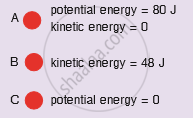
What is the kinetic energy of ball when it hits the ground?
A girl with having a mass of 35 kg sits on a trolley of mass 5 kg. The trolley is given an initial velocity of 4 m s–1 by applying a force. The trolley comes to rest after traversing a distance of 16 m. (a) How much work is done on the trolley? (b) How much work is done by the girl?
