Advertisements
Advertisements
प्रश्न
An iron sphere of mass 10 kg has the same diameter as an aluminium sphere of mass 3.5 kg. Both the spheres are dropped simultaneously from a tower. When they are 10 m above the ground, they have the same :
पर्याय
acceleration
momentum
potential energy
kinetic energy
Advertisements
उत्तर
Momentum, potential energy and kinetic energy depend on the mass of the body. So, the answer is acceleration as it is independent of mass.
Therefore, the answer is,
(a) Acceleration
संबंधित प्रश्न
In what way does the temperature of water at the bottom of a waterfall differ from the temperature at the top? Explain the reason.
Fill in the blank with suitable word :
The ability of a body to do work is called __________. The ability of a body to do work because of its motion is called __________.
What type of energy is possessed : by the piece of stone which is thrown away on releasing the stretched rubber strings of catapult?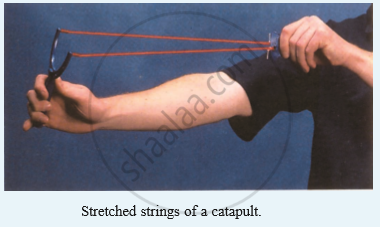
A boy weighing 40 kg makes a high jump of 1.5 m.
What is his kinetic energy at the highest point?
Fill in the blanks with suitable words:
When a ball is thrown upwards, ___________ energy is transformed into ___________ energy.
Five electric fans of 120 watts each are used for 4 hours. Calculate the electrical energy consumed in kilowatt-hours.
Write the energy transformations which take place in an electric bulb (or electric lamp).
Explain the transformation of energy in the following cases :
(i) A ball thrown upwards.
(ii) A stone dropped from the roof of a building.
A girl is carrying a school bag of 3 kg mass on her back and moves 200 m on a levelled road. The work done against the gravitational force will be (g = 10 m s–2)
An automobile engine propels a 1000 kg car (A) along a levelled road at a speed of 36 km h–1. Find the power if the opposing frictional force is 100 N. Now, suppose after travelling a distance of 200 m, this car collides with another stationary car (B) of the same mass and comes to rest. Let its engine also stop at the same time. Now the car (B) starts moving on the same level road without getting its engine started. Find the speed of the car (B) just after the collision.
