Advertisements
Advertisements
Question
A stone of mass 500 g is thrown vertically upwards with a velocity of 15 m/s. Calculate:
- the potential energy at the greatest height,
- the kinetic energy on reaching the ground, and
- the total energy at its half-way point.
Advertisements
Solution
(a) Mass of stone m = 500 g = `500/1000 = 1/2 kg`
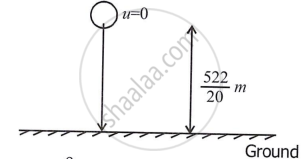
v = 0
u = 15 m/s
∴ v2 - u2 = 2gh
0 – 15 × 15 = 2gh
∴ gh = `(-225)/2`
10 h = `(-225)/2 or h = (-225)/(20) m`
A negative sign shows the stone is moving upward.
∴ Potential Energy = mgh
= `1/2 xx 10 xx 225/20`
= 56.25 J
(b) On the way back
u = 0, h = `225/20 m`, v = ?
v2 - u2 = 2gh
∴ v2 - 0 = `2 × 10 × 225/20`
∴ v2 - 0 = 225
∴ v = `sqrt225`
∴ v = 15 ms-1
K.E on reaching ground = `1/2 mv^2`
= `1/2 xx 1/2 xx 15 xx 15`
= 56.25 J
(c) Total energy at halfway point = mgh
= `1/2 xx 10 xx 225/20`
= 56.25 J
APPEARS IN
RELATED QUESTIONS
What is the difference between potential energy and kinetic energy?
Water stored in a dam possesses ______.
Name the device or machine which convert :
Chemical energy into electrical energy.
Name the device or machine which convert :
Light energy into electrical energy.
Name the device or machine which convert :
light energy into heat energy.
What kind of energy transformations take place at a coal-based thermal power station?
Write the energy transformations which take place in an electric bulb (or electric lamp).
A bulb lights up when connected to a battery. State the energy change which takes place :
Name the energy transfers which occur when there is a picture on a television screen.
An automobile engine propels a 1000 kg car (A) along a levelled road at a speed of 36 km h–1. Find the power if the opposing frictional force is 100 N. Now, suppose after travelling a distance of 200 m, this car collides with another stationary car (B) of the same mass and comes to rest. Let its engine also stop at the same time. Now the car (B) starts moving on the same level road without getting its engine started. Find the speed of the car (B) just after the collision.
