Advertisements
Advertisements
Question
Write the energy transformations which take place in an electric bulb (or electric lamp).
Advertisements
Solution
An electric bulb converts electrical energy into light energy. Electrical energy causes the filament in the bulb to become white-hot and give out light. So, in an electric bulb, the electrical energy is first converted into heat energy and then to light energy. This energy transformation can be written as,
Electrical energy → Heat energy → Light
RELATED QUESTIONS
Show that the sum of kinetic energy and potential energy (i.e., total mechanical energy) is always conserved in the case of a freely falling body under gravity (with air resistance neglected) from a height h by finding it when
- The body is at the top.
- the body has fallen a distance x.
- the body has reached the ground.
A pendulum is oscillating on either side of its rest position. The correct statement is:
State whether the object possess kinetic energy, potential energy, or both :
A stretched spring lying on the ground ____________.
What kind of energy is possessed by the following?
A running car ____________
What kind of energy is possessed by the following?
A stretched rubber band _____________
Fill in the blank with suitable word :
The sum of the potential and kinetic energies of a body is called __________ energy.
A boy weighing 40 kg makes a high jump of 1.5 m.
What is his kinetic energy at the highest point?
What are the various forms of energy?
What is the difference between potential energy and kinetic energy?
An iron sphere of mass 10 kg has the same diameter as an aluminium sphere of mass 3.5 kg. Both the spheres are dropped simultaneously from a tower. When they are 10 m above the ground, they have the same :
Name the device or machine which convert :
Light energy into electrical energy.
Fill in the blank with suitable word:
The electricity meter installed in our homes measure electrical energy in the units of ___________.
What do you understand by the term 'transformation of energy"? Explain with an example.
Name the energy transfers which occur when someone speaks into a microphone.
A ball falls to the ground as shown below :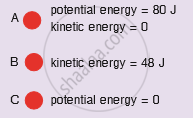
What is the kinetic energy of ball when it hits the ground?
Which one of the following is not the unit of energy?
The device which converts mechanical energy into energy which runs our microwave oven is :
In the case of negative work, the angle between the force and displacement is
A girl is carrying a school bag of 3 kg mass on her back and moves 200 m on a levelled road. The work done against the gravitational force will be (g = 10 m s–2)
A body of mass 10 kg falls from a height of 20 m to 8 m. Calculate:
- the loss in potential energy of the body, and
- the total energy possessed by the body at any instant? (Take g = 10 m s-2)
