Advertisements
Advertisements
Question
A microphone converts :
Options
electrical energy into sound energy in ordinary telephone
microwave energy into sound energy in a mobile phone
sound energy into mechanical energy is a stereo system
sound energy into electrical energy in public address system
Advertisements
Solution
A microphone converts sound energy into electrical energy in public address systems.
Therefore, the answer is, (d) Sound energy into electrical energy in public address system.
APPEARS IN
RELATED QUESTIONS
A body falls freely under gravity from rest. Name the kind of energy it will possess while falling.
A stone of mass 500 g is thrown vertically upwards with a velocity of 15 m/s. Calculate:
- the potential energy at the greatest height,
- the kinetic energy on reaching the ground, and
- the total energy at its half-way point.
A boy weighing 40 kg makes a high jump of 1.5 m.
What is his kinetic energy at the highest point?
Name the device or machine which convert :
light energy into heat energy.
Fill in the blanks with suitable words:
When a ball is thrown upwards, ___________ energy is transformed into ___________ energy.
The hanging bob of a simple pendulum is displaced to one extreme position B and then released. It swings towards centre position A and then to the other extreme position C. In which position does the bob have :
(i) maximum potential energy?
(ii) maximum kinetic energy?
How much electric energy in kWh is consumed by an electrical appliance of 1000 watts when it is switched on for 60 minutes?
A ball falls to the ground as shown below :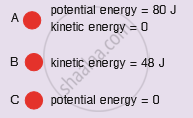
What is the kinetic energy of ball when it hits the ground?
Which of the following energy change involves frictional force?
An automobile engine propels a 1000 kg car (A) along a levelled road at a speed of 36 km h–1. Find the power if the opposing frictional force is 100 N. Now, suppose after travelling a distance of 200 m, this car collides with another stationary car (B) of the same mass and comes to rest. Let its engine also stop at the same time. Now the car (B) starts moving on the same level road without getting its engine started. Find the speed of the car (B) just after the collision.
