Advertisements
Advertisements
Question
A stone is thrown upwards as shown in the diagram. When it reaches P, which of the following has the greatest value of the stone?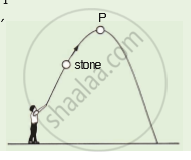
Options
its acceleration
its kinetic energy
its potential energy
its weight
Advertisements
Solution
When a stone is thrown vertically upwards, the following conclusions can be done for point P,
(a) The acceleration for the entire journey of the stone is constant, as acceleration due to gravity near the surface of the earth is constant.
(b) The velocity of the stone at P will be the least. Hence, kinetic energy at this point will be the least.
(c) The stone is at a maximum height at point P. Hence, the potential energy is the maximum at P.
(d) Weight of the stone will remain nearly constant, as acceleration due to gravity near the surface of the earth is constant.
Therefore, the answer is: (c) Its potential energy.
APPEARS IN
RELATED QUESTIONS
A ball is placed on a compressed spring. What form of energy does the spring possess? On releasing the spring, the ball flies away. Give a reason.
What kind of energy is possessed by the following?
A running car ____________
A boy weighing 40 kg makes a high jump of 1.5 m.
What is his kinetic energy at the highest point?
What is the difference between potential energy and kinetic energy?
Fill in the blanks with suitable words :
The principle of ___________ of energy says energy can be transformed from one form to another, but it cannot be ___________ or ___________.
What kind of energy transformations take place at a coal-based thermal power station?
How much electrical energy in joules does a 100 watt lamp consume : in 1 second?
Name the energy transfers which occur when a torch is on.
Which one of the following is not the unit of energy?
Which of the following energy change involves frictional force?
