Advertisements
Advertisements
प्रश्न
A stone is thrown upwards as shown in the diagram. When it reaches P, which of the following has the greatest value of the stone?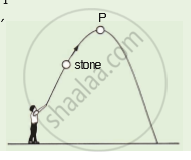
विकल्प
its acceleration
its kinetic energy
its potential energy
its weight
Advertisements
उत्तर
When a stone is thrown vertically upwards, the following conclusions can be done for point P,
(a) The acceleration for the entire journey of the stone is constant, as acceleration due to gravity near the surface of the earth is constant.
(b) The velocity of the stone at P will be the least. Hence, kinetic energy at this point will be the least.
(c) The stone is at a maximum height at point P. Hence, the potential energy is the maximum at P.
(d) Weight of the stone will remain nearly constant, as acceleration due to gravity near the surface of the earth is constant.
Therefore, the answer is: (c) Its potential energy.
APPEARS IN
संबंधित प्रश्न
State the condition under which the mechanical energy is conserved.
A stone of mass 500 g is thrown vertically upwards with a velocity of 15 m/s. Calculate:
- the potential energy at the greatest height,
- the kinetic energy on reaching the ground, and
- the total energy at its half-way point.
State whether the object possess kinetic energy, potential energy, or both :
A man climbing a hill _____________.
State whether the object possess kinetic energy, potential energy, or both :
A flying aeroplane _______________.
Name the device which converts electrical energy into mechanical energy.
What do you understand by the term 'transformation of energy"? Explain with an example.
When an object falls freely towards the earth, then its total energy :
In the case of negative work, the angle between the force and displacement is
A girl is carrying a school bag of 3 kg mass on her back and moves 200 m on a levelled road. The work done against the gravitational force will be (g = 10 m s–2)
A girl with having a mass of 35 kg sits on a trolley of mass 5 kg. The trolley is given an initial velocity of 4 m s–1 by applying a force. The trolley comes to rest after traversing a distance of 16 m. (a) How much work is done on the trolley? (b) How much work is done by the girl?
