Advertisements
Advertisements
प्रश्न
A ball of mass 0.20 kg is thrown vertically upwards with an initial velocity of 20 m s-1. Calculate the maximum potential energy it gains as it goes up.
Advertisements
उत्तर
Potential energy at the maximum height = initial kinetic energy
= `1/2` mv2
= `1/2×0.20 ×20 ×20`
= 40 J.
संबंधित प्रश्न
State whether the object possess kinetic energy, potential energy, or both :
A flying aeroplane _______________.
State whether the object possess kinetic energy, potential energy, or both :
A ceiling fan in the off position ______________
What kind of energy is possessed by the following?
Water stored in the reservoir of a dam __________.
A boy weighing 40 kg makes a high jump of 1.5 m.
What is his kinetic energy at the highest point?
A stone is thrown upwards as shown in the diagram. When it reaches P, which of the following has the greatest value of the stone?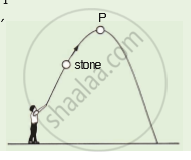
How much electrical energy in joules does a 100 watt lamp consume : in 1 second?
How much electrical energy in joules does a 100 watt lamp consume : in 1 minute?
Describe the energy changes which take place in a radio.
How much electric energy in kWh is consumed by an electrical appliance of 1000 watts when it is switched on for 60 minutes?
A girl with having a mass of 35 kg sits on a trolley of mass 5 kg. The trolley is given an initial velocity of 4 m s–1 by applying a force. The trolley comes to rest after traversing a distance of 16 m. (a) How much work is done on the trolley? (b) How much work is done by the girl?
