Advertisements
Advertisements
प्रश्न
An object is falling freely from a height x. After it has fallen a height `pi/2` , it will possess :
विकल्प
only potential energy
only kinetic energy
half potential and half kinetic energy
less potential and more kinetic energy
Advertisements
उत्तर
During the free fall, potential energy is gradually converted into kinetic energy. At half of the maximum height, energy is equally distributed in the form of potential and kinetic energy.
Therefore, the answer is, (c) Half potential and half kinetic.
APPEARS IN
संबंधित प्रश्न
Is energy a vector quantity?
What kind of energy is possessed by the following?
A stone kept on roof-top _______________
What type of energy is possessed : by the piece of stone which is thrown away on releasing the stretched rubber strings of catapult?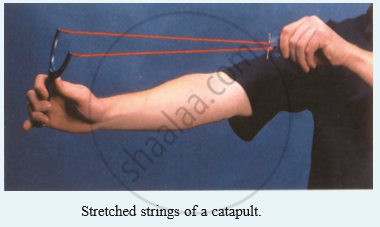
Two bodies having equal masses are moving with uniform speeds of v and 2v respectively. Find the ratio of their kinetic energies.
Water stored in a dam possesses ______.
Fill in the blanks with suitable words:
When a ball is thrown upwards, ___________ energy is transformed into ___________ energy.
How much electrical energy in joules does a 100 watt lamp consume : in 1 minute?
A bulb lights up when connected to a battery. State the energy change which takes place :
Name the energy transfers which occur when an electric ball rings.
Name the energy transfers which occur when someone speaks into a microphone.
