Advertisements
Advertisements
प्रश्न
An object is falling freely from a height x. After it has fallen a height `pi/2` , it will possess :
पर्याय
only potential energy
only kinetic energy
half potential and half kinetic energy
less potential and more kinetic energy
Advertisements
उत्तर
During the free fall, potential energy is gradually converted into kinetic energy. At half of the maximum height, energy is equally distributed in the form of potential and kinetic energy.
Therefore, the answer is, (c) Half potential and half kinetic.
APPEARS IN
संबंधित प्रश्न
A ball is placed on a compressed spring. What form of energy does the spring possess? On releasing the spring, the ball flies away. Give a reason.
State the condition under which the mechanical energy is conserved.
State whether the object possess kinetic energy, potential energy, or both :
A bird running on the ground ____________.
What type of energy is possessed : by the piece of stone which is thrown away on releasing the stretched rubber strings of catapult?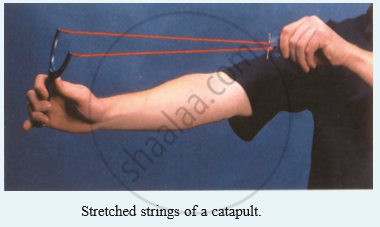
What is the difference between potential energy and kinetic energy?
A stone is thrown upwards as shown in the diagram. When it reaches P, which of the following has the greatest value of the stone?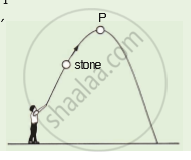
Fill in the blanks with suitable words:
When a ball is thrown upwards, ___________ energy is transformed into ___________ energy.
How much electric energy in kWh is consumed by an electrical appliance of 1000 watts when it is switched on for 60 minutes?
Which of the following energy change involves frictional force?
A girl with having a mass of 35 kg sits on a trolley of mass 5 kg. The trolley is given an initial velocity of 4 m s–1 by applying a force. The trolley comes to rest after traversing a distance of 16 m. (a) How much work is done on the trolley? (b) How much work is done by the girl?
