Advertisements
Advertisements
प्रश्न
Fill in the blanks with suitable words:
When a ball is thrown upwards, ___________ energy is transformed into ___________ energy.
Advertisements
उत्तर
When a ball is thrown upwards, kinetic energy is transformed into potential energy.
संबंधित प्रश्न
State the condition under which the mechanical energy is conserved.
A body falls freely under gravity from rest. Name the kind of energy it will possess while falling.
A pendulum is oscillating on either side of its rest position. The correct statement is:
State whether the object possess kinetic energy, potential energy, or both :
A man climbing a hill _____________.
State whether the object possess kinetic energy, potential energy, or both :
A flying aeroplane _______________.
What kind of energy is possessed by the following?
A stone kept on roof-top _______________
A boy weighing 40 kg makes a high jump of 1.5 m.
What is his kinetic energy at the highest point?
A boy weighing 40 kg makes a high jump of 1.5 m.
What is his potential energy at the highest point? (g = 10 m/s2)
A stone is thrown upwards as shown in the diagram. When it reaches P, which of the following has the greatest value of the stone?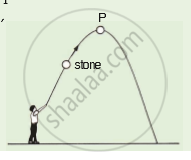
Name the device or machine which convert :
Mechanical energy into electrical energy.
Name the device or machine which convert :
Electrical energy into sound energy.
Name the device or machine which convert :
light energy into heat energy.
Write the energy transformations which take place in an electric bulb (or electric lamp).
Name the energy transfers which occur when there is a picture on a television screen.
A ball falls to the ground as shown below :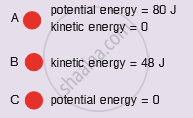
Which law you have made use of in answering this question?
An object is falling freely from a height x. After it has fallen a height `pi/2` , it will possess :
In the case of negative work, the angle between the force and displacement is
A body of mass 10 kg falls from a height of 20 m to 8 m. Calculate:
- the loss in potential energy of the body, and
- the total energy possessed by the body at any instant? (Take g = 10 m s-2)
