Advertisements
Advertisements
प्रश्न
A body of mass 10 kg falls from a height of 20 m to 8 m. Calculate:
- the loss in potential energy of the body, and
- the total energy possessed by the body at any instant? (Take g = 10 m s-2)
Advertisements
उत्तर
(i) Loss in potential energy = P.E at height 20 m – P.E. at height 8 m
= mg 20 – mg 8
= mg (20 – 8)
= mg (12) = 12 mg
= 10 × 10 × 12
= 1200 J
(ii) Say at a height 20 m above ground level
= P.E. + K.E.
= mgh + 0
= 10 × 10 × 20 + 0
= 2000 J
(∵ V = 0 when held at 10 m, Hence K.E. = 0)
APPEARS IN
संबंधित प्रश्न
A body falls freely under gravity from rest. Name the kind of energy it will possess while falling.
Is energy a vector quantity?
What type of energy is possessed : by the piece of stone which is thrown away on releasing the stretched rubber strings of catapult?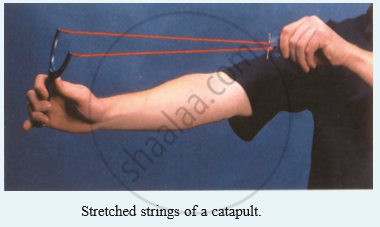
Give two examples where a body possesses both, kinetic energy as well as potential energy.
Name the device or machine which convert :
Chemical energy into heat energy.
Write the energy transformations which take place in an electric bulb (or electric lamp).
The hanging bob of a simple pendulum is displaced to one extreme position B and then released. It swings towards centre position A and then to the other extreme position C. In which position does the bob have :
(i) maximum potential energy?
(ii) maximum kinetic energy?
How much electric energy in kWh is consumed by an electrical appliance of 1000 watts when it is switched on for 60 minutes?
How much energy does a 100 W electric bulb transfer in 1 minute?
The device which converts mechanical energy into energy which runs our microwave oven is :
