Advertisements
Advertisements
प्रश्न
An automobile engine propels a 1000 kg car (A) along a levelled road at a speed of 36 km h–1. Find the power if the opposing frictional force is 100 N. Now, suppose after travelling a distance of 200 m, this car collides with another stationary car (B) of the same mass and comes to rest. Let its engine also stop at the same time. Now the car (B) starts moving on the same level road without getting its engine started. Find the speed of the car (B) just after the collision.
Advertisements
उत्तर
Here, mass of the car A, mA = 1000 kg
Initial speed of the car A, uA = 36 km h_1
= `36 xx 5/18`
= 10m s−1
Opposing frictional force, F = 100 N
∴ Power of the engine of car A
= F µA = (100 N) × (10 m s−1) = 1000 W
When car A collides with car B of mass 1000 kg,
Final speed of car A, vA = 0
Initial speed of car B, uB = 0
Applying conservation of momentum, P, = P,
mAvA + mBuB = mAvA + mBvB
1000 × 10 + 1000 x 0 = 1000 × o + 1000 × vB
∴ vB = 10m s−1
So, the speed of the car B just after the collision is 10m s−1
APPEARS IN
संबंधित प्रश्न
A ball of mass 0.20 kg is thrown vertically upwards with an initial velocity of 20 m s-1. Calculate the maximum potential energy it gains as it goes up.
What type of energy is possessed : by the piece of stone which is thrown away on releasing the stretched rubber strings of catapult?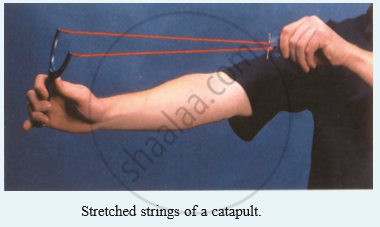
An iron sphere of mass 10 kg has the same diameter as an aluminium sphere of mass 3.5 kg. Both the spheres are dropped simultaneously from a tower. When they are 10 m above the ground, they have the same :
A stone is thrown upwards as shown in the diagram. When it reaches P, which of the following has the greatest value of the stone?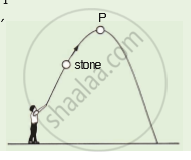
Describe the energy changes which take place in a radio.
What is the meaning of the symbol kWh? What quantity does it represent?
Name the energy transfers which occur when someone speaks into a microphone.
A ball falls to the ground as shown below :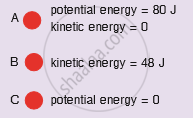
What is the kinetic energy of ball when it hits the ground?
When an object falls freely towards the earth, then its total energy :
An object is falling freely from a height x. After it has fallen a height `pi/2` , it will possess :
