Advertisements
Advertisements
प्रश्न
Show that the sum of kinetic energy and potential energy (i.e., total mechanical energy) is always conserved in the case of a freely falling body under gravity (with air resistance neglected) from a height h by finding it when
- The body is at the top.
- the body has fallen a distance x.
- the body has reached the ground.
Advertisements
उत्तर
The law of conservation of energy:
Energy can neither be created nor destroyed. Verification of the energy conservation law in the event of a body falling.
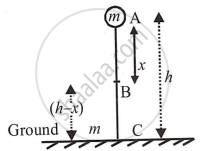
Consider a body of mass (m) raised above the ground to position A at a height (h).
(i) At A
P.E. = mgh
K.E. = 0 ...[∵ body is at rest]
∴ P.E. + K.E. = mgh + 0 = mgh ...(i)
Let it fall from A to B through a distance (x)
In doing so v2 - u2 = 2gx
v2 - 0 = 2gx ...[∴ u at A = 0]
Body is still at height (h - x) above ground.
(ii) At B, P.E. = mg (h - x)
K.E. = `1/2 mv^2`
= `1/2 m (2gx)`
= mgx
∴ P.E. + K.E. = mg (h - x) + mgx
= mgh - mgx + mgx
P.E. + K.E. = mgh
When a body falls on ground, the velocity with which it falls v2 - u2 = 2gh
v2 = 2gh
(iii) At C the ground
P.E. = 0 ...[∵ h = 0]
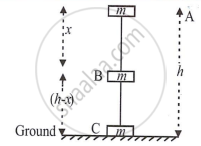
K.E. = `1/2 xx mv^2`
= `1/2 m (2gh)`
= mgh
P.E. + K.E. = 0 + mgh = mgh ...(iii)
This we find in all three cases (i), (ii) and (iii)
The sum total of P.E. + K.E. = mgh which remains constant and hence verifies the law.
APPEARS IN
संबंधित प्रश्न
State whether the object possess kinetic energy, potential energy, or both :
A man climbing a hill _____________.
A stone is thrown upwards as shown in the diagram. When it reaches P, which of the following has the greatest value of the stone?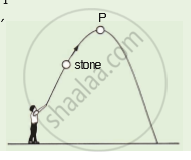
Name the device which converts electrical energy into mechanical energy.
Name the device or machine which convert :
Mechanical energy into electrical energy.
Name the device or machine which convert :
Chemical energy into electrical energy.
How much electrical energy in joules does a 100 watt lamp consume : in 1 minute?
A bulb lights up when connected to a battery. State the energy change which takes place :
Explain the transformation of energy in the following cases :
(i) A ball thrown upwards.
(ii) A stone dropped from the roof of a building.
When an object falls freely towards the earth, then its total energy :
A microphone converts :
