Advertisements
Advertisements
प्रश्न
Gravitational potential energy U = mass × force of gravity on unit mass × ..........
Advertisements
उत्तर
Gravitational potential energy U = mass × force of gravity on unit mass × height.
APPEARS IN
संबंधित प्रश्न
A mass of 10 kg is at a point A on a table. It is moved to a point B. If the line joining A and B is horizontal, what is the work done on the object by the gravitational force? Explain your answer.
Two bodies A and B of masses 10 kg and 20 kg respectively are at the same height above the ground. Which of the two has greater potential energy?
Two bodies of same masses are placed at heights h and 2h. Compare their gravitational potential energy.
A body at a height possesses ______.
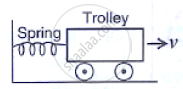
A spring is kept compressed by a small trolley of mass 0.5 kg lying on a smooth horizontal surface as shown in the adjacent fig. When the trolley is released, it is found to move at a speed v = 2 m s-1. What potential energy did the spring possess when compressed?
Is potential energy a vector or a scalar quantity?
What happens to the potential energy of a body when its height is doubled?
If 784 J of work was done in lifting a 20 kg mass, calculate the height through which it was lifted. (g = 9.8 m/s2)
A car is accelerated on a levelled road and acquires a velocity 4 times of its initial velocity. During this process, the potential energy of the car :
The potential energy of your body is least when you are ______.
