Advertisements
Advertisements
प्रश्न
If we increase the velocity of a car moving on a flat surface to four times its original speed, its potential energy ______.
पर्याय
will be twice its original energy
will not change
will be 4 times its original energy
will be 16 times its original energy.
Advertisements
उत्तर
If we increase the velocity of a car moving on a flat surface to four times its original speed, its potential energy will not change.
Explanation:
The energy stored in an object because of its specific state or position is called its potential energy. The potential energy is expressed by the following formula (P.E.) = mgh. That is, the potential energy of an object does not depend on its velocity, but on its height above the ground.
APPEARS IN
संबंधित प्रश्न
A mass of 10 kg is at a point A on a table. It is moved to a point B. If the line joining A and B is horizontal, what is the work done on the object by the gravitational force? Explain your answer.
The potential energy of a freely falling object decreases progressively. Does this violate the law of conservation of energy? Why?
Gravitational potential energy U = mass × force of gravity on unit mass × ..........
State two factors on which the potential energy of a body at a certain height above the ground depends.
A bucket full of water is on the first floor of your house and another identical bucket with the same quantity of water is kept on the second floor. Which of the two has greater potential energy?
Define the term potential energy of a body.
A spring is kept compressed by a small trolley of mass 0.5 kg lying on a smooth horizontal surface as shown in the adjacent fig. When the trolley is released, it is found to move at a speed v = 2 m s-1. What potential energy did the spring possess when compressed?
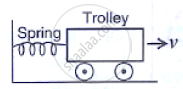
Is potential energy a vector or a scalar quantity?
State whether the following statement is true or false :
The potential energy of a body of mass 1 kg kept at a height of 1 m is 1 J.
A weightlifter is lifting weights of mass 200 kg up to a height of 2 metres. If g = 9.8 m s−2, calculate :
work done by the weightlifter
A boy weighing 50 kg climbs up a vertical height of 100 m. Calculate the amount of work done by him. How much potential energy does he gain? (g = 9.8 m/s2)
To what height should a box of mass 150 kg be lifted, so that its potential energy may become 7350 joules? (g = 9.8 m/s2)
What is the difference between gravitational potential energy and elastic potential energy? Give one example of a body having gravitational potential energy and another having elastic potential energy.
If 784 J of work was done in lifting a 20 kg mass, calculate the height through which it was lifted. (g = 9.8 m/s2)
Prove that the kinetic energy of a freely falling object on reaching the ground is nothing but the transformation of its initial potential energy.
How much energy is gained by a box of mass 20 kg when a man, raises the box by 0.5 m in order to place it inside the bus? (g=10 m/s-2)
The energy, possessed by an object due to its position is called ______.
A body is falling from a height of h. After it has fallen a height `"h"/2`, it will possess
