Advertisements
Advertisements
प्रश्न
The work done on an object does not depend on ______.
पर्याय
displacement
applied force
initial velocity of the object
the angle between force and displacement.
Advertisements
उत्तर
The work done on an object does not depend on the initial velocity of the object.
Explanation:
W = Fs cosθ
According to the formula of work, we come to know that the work done on an object does not depend on the initial velocity of the object.
APPEARS IN
संबंधित प्रश्न
The energy of a body is its capacity to do .........
State two conditions when no work is done by a force.
In which of the following cases, is work being done?
(i) A man pushing a wall.
(ii) a coolie standing with a load of 12 kgf on his head.
(iii) A boy climbing up a staircase.
State two advantage of producing hydroelectricity.
State the energy transformation on the following:
Electricity is obtained from solar energy.
How much work is done when a body of mass m is raised to a height h above the ground?
Define 1 joule of work.
If the work done by a force in moving an object through a distance of 20 cm is 24.2 J, what is the magnitude of the force?
P, Q and R are three forces which act as shown in fig.
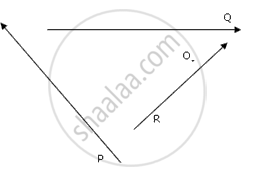
The point O lies in the same plane. Given, P = Q = R = 10N
(i) Which force has the least moment about O? Give a reason.
(ii)Which force has the greatest moment about O? Give a reason.
Can work done be zero even if force acts on the body?
Name the physical quantity associated with the 'rate of doing work'.
A 100 W electric lamp emits energy in the form of light at the rate 10 J per second. What percentage of electric energy does the lamp transform into light energy?
________ is said to be done when a force is acting on it.
A ______ should act on an object.
A car is accelerated on a levelled road and attains a velocity 4 times of its initial velocity. In this process the potential energy of the car
A proton is kept at rest. A positively charged particle is released from rest at a distance d in its field. Consider two experiments; one in which the charged particle is also a proton and in another, a positron. In the same time t, the work done on the two moving charged particles is ______.
