Advertisements
Advertisements
प्रश्न
- Take two aluminium channels of different lengths.
- Place the lower ends of the channels on the floor and hold their upper ends at the same height.
- Now take two balls of the same size and weight and release them from the top end of the channels. They will roll down and cover the same distance.
- At the moment of releasing the balls, which energy do the balls have?
- As the balls roll down which energy is converted into which other form of energy?
- Why do the balls cover the same distance on rolling down?
Note: The question is wrong. It should be "Why do the balls cover the same distance after rolling down"? - What is the form of the eventual total energy of the balls?
- Which law related to energy does the above activity demonstrate? Explain.
Advertisements
उत्तर
- At the moment of releasing the balls, they possess potential energy.
- The potential energy of the balls converts to kinetic energy as they roll down.
- The balls will possess the same potential energy because the channels are of the same height as well as the weight of the balls being the same. So, the balls reaching the bottom of their respective channels will possess the same kinetic energy (following the law of conservation of energy). Thus, the balls will have the same velocity at the bottom of the channel. Because of the same velocity, they will cover equal distance on the ground. Thus, both the balls cover equal distance after rolling down the incline because they possessed the same potential energy at the top of the channels.
- The total energy of the ball will eventually be in the form of kinetic energy.
- The law of conservation of energy is demonstrated using this activity. At the top of the channels, the total mechanical energy of the balls is in the form of potential energy. Now, as the balls roll down, they come into motion. This motion shows that the balls now possess kinetic energy too. As the law of conservation of energy states that energy cannot be created nor destroyed, this means this kinetic energy came into existence because of a decrease in the potential energy of the ball (a decrease in potential energy is due to a decrease in height). Also, when the ball reaches the bottom, the total mechanical energy of the ball is in the form of kinetic energy. This shows that all the potential energy of the balls got converted to kinetic energy at the bottom.
APPEARS IN
संबंधित प्रश्न
Write true or false of the following statement.
Potential energy changes into kinetic energy when it is put to use
Fill in the blank
An electric fan converts electrical energy into ______ energy.
Fill in the blank
The S.I.unit of energy is ______
Match the following columns
| COLUMN A | COLUMN B |
| 1. Running water | 1. heat energy |
| 2. Burning | 2. vibrations |
| 3.Energy | 3.atom bomb |
| 4.Sound energy | 4.kinetic energy |
| 5.Nuclear energy | 5.joule |
Select the correct alternatives
The correct statement is
State the unit of energy and define it.
State two factors on which the potential energy of a body at a certain height above the ground depends.
Match the following:
| Column A | Column B |
| (a) Needle | (1) class II lever |
| (b) Doorknob | (2) inclined plane |
| (c) Ramp | (3) Class I lever |
| (d) Lemon crusher | (4) Wheel and axle |
| (e) Seesaw | (5) wedge |
Define the term efficiency of a machine.
Tick the most appropriate answer.
The force applied on a machine to do work is called the
Name the commercial unit of measurement of energy.
Name two units of power bigger than watt.
How many joules are there in one kilowatt-hour?
If the energy of a ball falling from a height of 10 metres is reduced by 40%, how high will it rebound?
Can you tell?
When can we say that displacement has taken place?
We make useful objects from a variety of substances. Another use of substances is that we get energy from some of them.
There is a car. Its tank is full of fuel but it does not move. Why is that?
We make useful objects from a variety of substances. Another use of substances is that we get energy from some of them.
When we have run a long distance, we feel tired. We have to stop. Why is that?
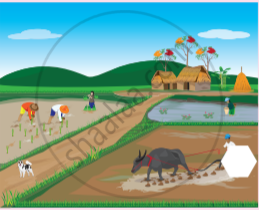
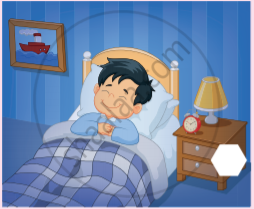
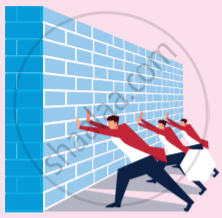
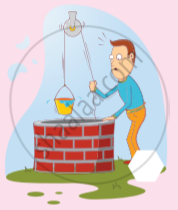
Observe the picture and put a tick (✓) if work is done and put a cross (x) if work is not done.
 |
 |
 |
 |
 |
 |
What energy transfer happen in a car engine?
When a body falls freely towards the earth, then its total energy
