Advertisements
Advertisements
Question
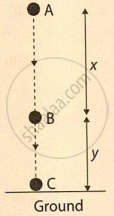
An object of mass ‘m’ is allowed to fall freely from point A as shown in the figure. Calculate the total mechanical energy of the object at:
- Point A
- Point B
- Point C
- State the law which is verified by your calculations in parts (i), (ii) and (iii).
Advertisements
Solution
(i) Since at point A, height is x + y and velocity = 0
Total energy at A = P. E. at A + K. E. at A
= `mg (x + y) + 1/2 xx m xx 0^2`
= mg (x + y)
(ii) At point B, height is y and velocity = v1
Total energy at B = P. E. at B + K. E. at B
= `mg y + 1/2 mv_1^2`
But `v_1^2` = u2 + 2 gh
`v_1^2` = 2 gx ...[∵ u = 0 during free fall]
∴ Total energy at B = `mg y + 1/2 m xx 2 gx`
= mg (x + y)
(iii) At point C, height = 0 and velocity = v2
Total energy at C = P. E. at C + K. E. at C
= `0 + 1/2 mv_2^2`
But `v_2^2` = u2 + 2 gh
`v_2^2` = 0 + 2g (x + y)
`v_2^2` = 2g (x + y)
∴ Total energy at C = `1/2 m xx 2g (x + y)`
= mg (x + y)
Since the total energy at points A, B, and C is exactly the same, i.e., mg (x + y), the law of conservation of energy is successfully verified.
