Advertisements
Online Mock Tests
Chapters
![Lakhmir Singh solutions for Physics [English] Class 10 ICSE chapter 1 - Force - Shaalaa.com](/images/physics-english-class-10-icse_6:bfbcc704031b4fd398b72f80ee978e3f.jpg "Lakhmir Singh solutions for Physics [English] Class 10 ICSE chapter 1 - Force")
Advertisements
Solutions for Chapter 1: Force
Below listed, you can find solutions for Chapter 1 of CISCE Lakhmir Singh for Physics [English] Class 10 ICSE.
Lakhmir Singh solutions for Physics [English] Class 10 ICSE 1 Force Intex Question [Pages 3 - 13]
TEST YOUR UNDERSTANDING - 1
Write the numerical expression of force.
State the various effects of force.
State S.I. unit of force.
Write the CGS unit of force.
Why does a bicycle begin to slow down when you stop pedalling?
Write two examples of translational motion.
Write two examples of rotational motion.
Write two examples of contact force.
Write two examples of non-contact force.
Is force a scalar or a vector quantity?
THINK AND ANSWER
There are 12 students in a playground; 11 weigh exactly the same, but one of them is slightly lighter or heavier. There is a seesaw to determine who is the odd one out. Find out the minimum number of times the seesaw will be used.
THINK AND ANSWER
If a body is rotating, is it necessarily being acted upon by an external torque?
TEST YOUR UNDERSTANDING - 2
State two factors on which affect moment of force.
Obtain the relation between the SI unit and CGS unit of torque.
Why is a long rigid rod used to rotate the jack in a car?
You and your brother are sitting on either side of a seesaw. Who must sit near the fulcrum to balance the seesaw? Assume your brother has more weight than you.
Write two examples of static equilibrium.
Write three examples of application of torque.
Write S.I. unit of moment of couple.
TEST YOUR UNDERSTANDING - 3
State the principle of moments.
Name one device where the principle of moments applies.
Write the expression for the principle of moments.
A uniform metre scale of mass 70 g is suspended from the 65 cm mark on the scale. Where should a 50 g mass be suspended on the scale to keep the scale in the horizontal position?
A nut can be opened by applying a moment of force 90 N m. If a mechanic can apply a maximum force of 150 N, what should be the length of the lever to open the nut?
Draw a neat labelled diagram to show the direction of two forces acting on a body to produce rotation in it. Also, mark the point about which rotation takes place by the letter O.
THINK AND ANSWER
Where is the centre of gravity of a donut?
Why is it that the Leaning Tower of Pisa, Italy, does not topple over?
TEST YOUR UNDERSTANDING - 4
What is the position of the CG of a uniform rod?
State whether the position of CG will remain the same or not if a body is deformed.
Write the position of the centre of gravity for a hollow cone, a hollow sphere, and a parallelogram.
What is the position of the centre of gravity of a rectangular lamina?
What is the position of the centre of gravity of a cylinder?
THINK AND ANSWER
How do wet clothes dry up in a washing machine?
Why does a cyclist bend inwards from his vertical position while taking a turn?
TEST YOUR UNDERSTANDING - 5
Discuss the nature of centrifugal force.
What is the effect of centripetal force?
What remains constant in uniform circular motion ?
The road is not levelled on sharp bends. Why?
Can you accelerate a particle at a uniform speed?
A body of mass 2 kg moves with a velocity of 5 m/s on a circular track. Calculate the centripetal force required to keep the body in uniform circular motion. The radius of circular path is 1 m.
Lakhmir Singh solutions for Physics [English] Class 10 ICSE 1 Force EXERCISE [Pages 14 - 18]
Objective Questions
True or False.
By applying force on a moving body, we can change the direction of motion.
True or False.
The SI unit of moment of force is dyne сm.
True or False.
The centre of gravity of a square lies at a point of intersection of its diagonal.
True or False.
In the uniform circular motion, velocity is constant.
True or False.
The couple has the same unit as a moment of force.
Fill in the Blanks
Newton and dyne are related as ______.
The formula of centripetal force is ______.
The centre of gravity of a uniform rod of length (l) lies at ______ distance.
In the case of uniform circular motion, speed is always ______.
Anti-clockwise moment is always taken as ______.
Match the Following:
| Column A | Column B |
| (i) Force | (a) Pseudo force |
| (ii) Moment of force | (b) ma |
| (iii) Centripetal force | (c) F × r |
| (iv) Centrifugal force | (d) Real force |
Match the Following:
| Column A | Column B |
| (i) Clockwise moment | (a) Contact force |
| (ii) Anti-clockwise moment | (b) Non-contact force |
| (iii) Friction | (c) Positive |
| (iv) Electric force | (d) Negative |
Match the Following:
| Column A | Column B |
| (i) Seesaw | (a) Centripetal force |
| (ii) Opening a water tap | (b) Torque |
| (iii) Bending of cyclist | (c) Centrifugal force |
| (iv) Merry-go-round | (d) Couple |
Multiple Choice Questions
A body of mass 2 kg is sliding with a constant velocity of 5 m/s on a frictionless horizontal table. The force required to continue the motion is:
10 N
5 N
0 N
20 N
The tendency of rotation of the body along any axis is called ______.
force
moment of force
velocity
centre of gravity
Which of the following quantity remains constant in a uniform circular motion?
Velocity
speed
acceleration
Both velocity and speed
None of these
The centrifugal force is ______.
a real force
a negative force
an increasing force
a pseudo or fictitious force
The SI unit of couple is ______.
N
N/m
N m
J m
N m−1
N m−2
The diameter of a steering wheel is 60 cm. The couple applied on the wheel when two equal and opposite forces of 10 N is applied on the rim of the wheel is:
4 N m
6 N m
8 N m
60 N m
The centre of gravity of a solid cone having height h lies at ______.
the centre of the cone
the base of the cone
a height `h/4` from the base of the cone
none of these
A nut is opened using a wrench of length 10 cm. If a moment of force of 0.5 N m is developed, then the amount of force required is:
5 N
10 N
0.1 N
0.5 N
The centre of gravity of a cricket ball is at ______.
its topmost point
any point on its surface
its bottom, touching the ground
its geometric centre
Calculate the length of the arm of couple if a force of 13 N produces a moment of couple of 14.3 N m.
14.3 × 13 dyne cm
14.3 ÷ 13 m
14.3 + 13 dyne cm
14.3 − 13 dyne cm
Descriptive Questions Short Answer Questions
Name the force required for circular motion.
Is force a scalar or a vector quantity?
What is the position of the centre of gravity of a cylinder?
Is stone moving with a uniform acceleration considered to be in uniform circular motion?
Are SI and CGS units of force related?
Write the SI unit of torque.
On which principle does the physical balance work?
Its moment of a force scalar or a vector quantity?
Write the expression for calculating the moment of force about a given axis.
What do you mean by an equilibrium of a body?
State the condition when a force produces translational motion.
Is centrifugal force considered as the force of reaction of the centripetal force?
Write the expression for centrifugal force.
Define one newton.
Derive a relation between the S.I. and C.G.S. unit of force.
Where does the position of centre of gravity lie for a circular lamina?
At which point is the centre of gravity situated in a triangular lamina?
Give any two effects of a force on a non-rigid body.
How does the magnitude of this non-contact force on the two bodies depend on the distance of separation between them?
What causes centripetal acceleration?
Why does a spanner have a long handle?
What do you understand by the clockwise and anti clockwise moment of force?
State two factors on which moment of the force about a point depends.
Explain the meaning of uniform circular motion. Give one example of such motion.
Write the difference between uniform translational motion and uniform circular motion.
Name two units of the moment of force. State the relation between them.
What is meant by equilibrium?
State the conditions of equilibrium of a body?
What do you understand by the term couple?
State the couple's effect on a body.
Give two examples of couple actions in our daily life.
Draw a neat labelled diagram for a particle moving in a circular path with a constant speed. In you diagram show the direction of velocity at any instant.
Distinguish between centripetal and centrifugal force.
Explain the motion of a planet around the sun in a circular path.
Long Answer Questions
Explain the meaning of uniform circular motion. Give one example of such motion.
Prove that
Moment of couple = Force × couple arm.
What is meant by the term ‘moment of force’? If the moment of force is assigned a negative sign then will the turning tendency of the force be clockwise or anti-clockwise?
State the condition when a body is in static equilibrium.
State the condition when a body is in dynamic equilibrium.
Describe a simple experiment to verify the principle of moments, if you are supplied with a metre rule, a fulcrum and two springs with slotted weights.
Numerical Problems
A 5 N.m torque is required to open a bolt. Calculate the amount of force to be applied on the spanner at a length of 25 cm from the bolt.
The moment of a force of 10 N about a fixed point O is 5 N m. Calculate the distance of the point O from the line of action of the force.
A boy of mass 30 kg is fitting at a distance of 2 m from the middle of a see-saw. Where should a boy of mass 40 kg sit so as to balance the see-saw?
A man can open a nut by applying a force of 150 N by using a lever handle of length 0.4 m. What should be the length of the handle if he is able to open it by applying a force of 60 N?
A uniform metre scale balances horizontally at the 44 cm mark when a weight of 20 g is placed at the 15 cm mark. What is the weight of the metre scale?
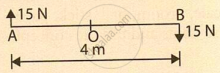
The figure shows a bar AB pointed in the middle at point O. Two forces, 15 N each, act on this bar at ends A and B in the opposite direction. What is the magnitude of the resultant moment of force about point O?
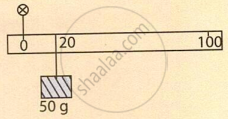
A metre scale is pivoted from the 0 cm mark and is free to rotate in the vertical plane. A 50 g weight is suspended from the 20 cm mark as shown in the figure. Calculate the moment of force in gf × cm and in N m.
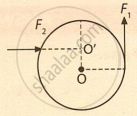
The figure shows a wheel of radius 5 cm that can rotate freely about the point O. It is in equilibrium due to the forces F1 and F2 acting on it. Which one of the forces F1 and F2 is the greater force? What is the ratio of the two forces? Given OO' = 3 cm.
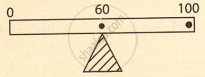
A uniform metre scale rests on a knife edge at the 60 cm mark. The scale becomes horizontal when a mass of 12 g is suspended from the one end of the scale. Which end of scale is this? What is the mass of the scale?
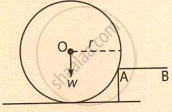
The figure shows a heavy wheel of mass w that can rotate freely about the axis passing through the point O. The wheel is to be raised on the pavement AB by applying a minimum force. Show the direction of application of force and calculate its magnitude.
Three equal forces P, Q and R act in a plane but in different directions. The point O also lies in the same plane. Which force has the least moment about O? Which force has the largest moment about O? Give reasons to your answer.

DO IT RIGHT
Research on the internet and make a presentation on the different types of force, showing the different effects of these forces. Explain with real-life examples.
Collect a few items of different shapes, such as metre scale, broom, ball, stick, paper cutouts of different shapes and so on. Try to balance these items and use the concepts learned in the chapter to find out their centre of gravity.
Solutions for 1: Force
Lakhmir Singh solutions for Physics [English] Class 10 ICSE chapter 1 - Force
Shaalaa.com has the CISCE Mathematics Physics [English] Class 10 ICSE CISCE solutions in a manner that help students grasp basic concepts better and faster. The detailed, step-by-step solutions will help you understand the concepts better and clarify any confusion. Lakhmir Singh solutions for Mathematics Physics [English] Class 10 ICSE CISCE 1 (Force) include all questions with answers and detailed explanations. This will clear students' doubts about questions and improve their application skills while preparing for board exams.
Further, we at Shaalaa.com provide such solutions so students can prepare for written exams. Lakhmir Singh textbook solutions can be a core help for self-study and provide excellent self-help guidance for students.
Concepts covered in Physics [English] Class 10 ICSE chapter 1 Force are .
Using Lakhmir Singh Physics [English] Class 10 ICSE solutions Force exercise by students is an easy way to prepare for the exams, as they involve solutions arranged chapter-wise and also page-wise. The questions involved in Lakhmir Singh Solutions are essential questions that can be asked in the final exam. Maximum CISCE Physics [English] Class 10 ICSE students prefer Lakhmir Singh Textbook Solutions to score more in exams.
Get the free view of Chapter 1, Force Physics [English] Class 10 ICSE additional questions for Mathematics Physics [English] Class 10 ICSE CISCE, and you can use Shaalaa.com to keep it handy for your exam preparation.
