Advertisements
Advertisements
Question
How does the magnitude of this non-contact force on the two bodies depend on the distance of separation between them?
Advertisements
Solution
The magnitude of non-contact forces acting on two bodies depends on the distance of separation between them. The magnitude of force decreases with an increase in separation and increases as the separation decreases. It varies inversely as the square of the distance of separation.
RELATED QUESTIONS
Less force is needed when applied at a farther distance from the pivoted point.
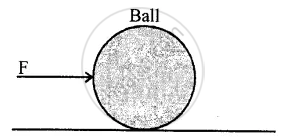
State the effect of force F in of the following diagram.
A tall building has wide foundations.
Classify the following amongst contact and non-contact force.
force of tension in a string
State two factor on which moment of force about a point depends.
It is easier to turn the steering wheel of a large diameter than that of a small diameter. Given reason.
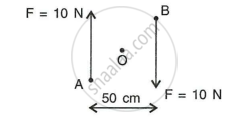
The figure shows two forces each of magnitude 10 N acting at the point A and B at a separation of 50 cm, in opposite directions. Calculate the resultant moment of two forces about the point.
- A,
- B and
- O situated exactly at the middle of the two forces.
Classify the following amongst contact and non-contact forces.
electrostatic force
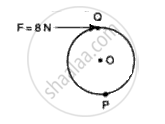
A wheel of diameter 3 m is shown in fig. 2 with axle at 0. A force F = 8 N is applied at Q in the direction shown in figure. Calculate the moment of force about:
(i) centre o, and
(ii) point p.
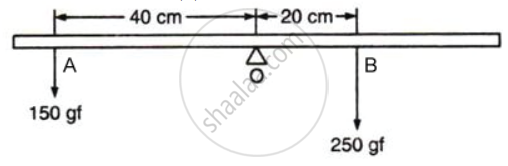
The diagram shows a uniform metre rule weighing 100gf, pivoted at its centre O. Two weights 150gf and 250gf hang from the point A and B respectively of the metre rule such that OA = 40 cm and OB = 20 cm. Calculate :
the difference of anticlockwise and clockwise moment