Advertisements
Online Mock Tests
Chapters
![Lakhmir Singh solutions for Physics [English] Class 10 ICSE chapter 10 - Electromagnetism - Shaalaa.com](/images/physics-english-class-10-icse_6:bfbcc704031b4fd398b72f80ee978e3f.jpg "Lakhmir Singh solutions for Physics [English] Class 10 ICSE chapter 10 - Electromagnetism")
Advertisements
Solutions for Chapter 10: Electromagnetism
Below listed, you can find solutions for Chapter 10 of CISCE Lakhmir Singh for Physics [English] Class 10 ICSE.
Lakhmir Singh solutions for Physics [English] Class 10 ICSE 10 Electromagnetism Intex Question [Pages 233 - 248]
THINK AND ANSWER
How do magnets attract or repel? Can they stick to all types of metals?
How can you find out the north and south poles of a magnet using another magnet with its north and south poles clearly labelled?
The core of an electromagnet must be made of soft iron. Why? What happens if soft iron is replaced with steel?
TEST YOUR UNDERSTANDING - 1
What is the use of a permanent magnet?
What will happen to a magnetic needle when it is brought close to a current-carrying conductor?
State the law which is used to find the direction of magnetic field lines.
Describe some experiment to show that the magnetic field is associated with an electric current.
Name two factors on which the strength of magnetic field of an electromagnet depends ?
State the principle of a D. C. motor.
Name the device which is used to reverse the direction of current in the coil of a motor?
State the factors that can increase the speed of rotation of the coil in a D.C. motor.
Why is an electromagnet used in an electric bell?
State two differences between an electromagnet and a permanent magnet.
When is the force experienced by a current-carrying conductor placed in a magnetic field largest?
State whether the following statement is true or false.
Fleming's right-hand rule is used for finding the direction of a force in a DC motor.
State whether the following statement is true or false.
The denser is the magnetic field lines, the stronger is the magnetic field.
Which of the following is not part of the simple motor?
Commutator
Brushes
Bar magnet
Armature
Fill in the following blanks with suitable words.
______ force experienced by a charge travelling in a magnetic field against the direction of the magnetic field.
A DC motor converts ______ energy to ______ energy.
THINK AND ANSWER
If you hold a coil of wire next to a magnet, no current will flow in the coil. What else is needed to induce a current?
THINK AND ANSWER
Can a magnet with a single pole actually exist?
THINK AND ANSWER
Why do we not use DC for power transmission? Is it possible to supply DC directly to homes in place of AC?
THINK AND ANSWER
Can you think of a few applications of AC generators?
THINK AND ANSWER
A portable radio has a built-in transformer so that it can work from the mains instead of batteries. Is this a step-up or step-down transformer?
TEST YOUR UNDERSTANDING - 2
On which factors the direction of induced emf depends?
How can we increase the maximum value of emf induced in an AC generator?
Define a Transformer.
Explain the construction and working of the transformer.
How is an emf induced in an AC generator?
State five differences between an AC generator and a DC motor.
State Faraday’s laws of electromagnetic induction.
State whether the following statement is true or false.
In a step-down transformer, the number of turns in the primary coil is more than the number of turns in secondary coil.
State whether the following statement is true or false.
A transformer works on the principle of electromagnetic induction.
Choose the correct option for the following question.
A step-up transformer is used in ______.
generating electricity
increasing the voltage
decreasing the voltage
converting AC to DC
The frequency of alternating current (a.c.) supply in India is ______.
0 Hz
50 Hz
60 Hz
100 Hz
Fill in the following blanks with suitable words.
Lenz's law is used to find the direction of ______ in AC generators.
In ______ current, polarity reverses with time.
Lakhmir Singh solutions for Physics [English] Class 10 ICSE 10 Electromagnetism EXERCISE [Pages 250 - 256]
Objective Questions
True or False.
An AC generator converts mechanical energy to electrical energy.
True or False:
Force on a current-carrying conductor depends upon the area of cross-section of the conductor.
True or False:
Electrical energy converts into mechanical energy when a magnet is moved towards a coil.
True or False.
A transformer uses direct current.
True or False.
Alternating current can be used for long-distance transmission of electricity.
Fill in the Blanks
When current flows in a coil, it creates a ______.
A current-carrying solenoid is a prime example of ______.
Fleming's left-hand rule is used to find the direction of motion in a ______.
______ transformer is used to convert low voltage to high voltage.
A DC motor contains a kind of switch called a ______ which reverses the direction of current.
Multiple Choice Questions
Which of the following correctly describes the magnetic field near a long straight wire?
The field consists of straight lines perpendicular to the wire
The field consists of straight lines parallel to the wire
The field consists of radial lines originating from the wire
The field consists of concentric circles centred on the wire
Electromagnetic induction is the process of ______.
charging a body
generation of a magnetic field due to the current passing through a coil
generation of induced current in a coil due to relative motion between a magnet and the coil
rotation of a coil of an electric motor
The device used for producing electric current is called a ______.
generator
galvanometer
ammeter
motor
Two coils are wound on a non-conducting cylindrical rod as shown in the figure. Initially, the key is open. Now, if the key is closed and later set as open,
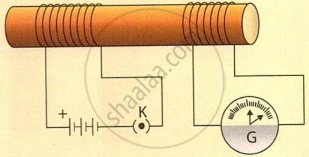
the deflection in the galvanometer will remain zero.
there will be a momentary deflection in the galvanometer, but it dies out shortly and there is no effect when the key is set open.
there are momentary galvanometer deflections that die out shortly; the deflections are in the same direction.
there are momentary galvanometer deflections that die out shortly; the deflections are in opposite directions.
Choose the incorrect statement
Fleming’s right-hand rule is a simple rule to know the direction of induced current
The right-hand thumb rule is used to find the direction of magnetic fields due to current carrying conductors
The difference between the direct and alternating currents is that the direct current always flows in one direction, whereas the alternating current reverses its direction periodically
In India, the AC changes direction after every `1/50` second
Which of the following can be applied to determine the direction of the induced current?
Clock face rule
Fleming's right-hand rule
Right-hand thumb rule
Fleming's left-hand rule
In a step-down transformer, ______.
Ns = Np
Ns < Np
Ns > Np
all of the above options are correct
The presence of a magnetic field at a place can be detected using ______.
a solenoid
a compass
an electromagnet
a galvanometer
The magnetic field inside a long straight solenoid carrying current ______.
is zero
decreases as we move towards its end.
increases as we move towards its end.
is same at all points.
Force on a current-carrying conductor is directly proportional to:
current
magnetic field
length of the wire
all of the above
On reversing the direction of current in a wire, the magnetic field produced by it ______.
increases in intensity
remains unaffected
reverses in direction
decreases in intensity
Match the items of Column I with that of Column II and choose the appropriate code.
| Column I | Column II |
| A. AC generator | (i) regulates voltage |
| B. Transformer | (ii) converts electrical energy into mechanical energy |
| C. DC motor | (iii) converts AC to DC |
| D. Rectifier | (iv) converts mechanical energy into electrical energy |
A - (iii), B - (ii), C - (i), D - (iv)
A - (i), B - (iii), C - (ii), D - (iv)
A - (iv), B - (i), C - (ii), D - (iii)
A - (iii), B - (i), C - (ii), D - (iv)
Descriptive Questions Short Answer Questions
State Fleming’s left-hand rule.
State two ways by which the strength of the magnetic field of an electromagnet can be increased?
What is electromagnetic induction?
State Lenz's Law.
Explain the use of the right-hand thumb rule.
What is the principle behind the working of a transformer?
Write any two uses of step-up transformer.
Write any two uses of step-down transformer.
Draw a simple labelled diagram of a U-shaped electromagnet.
State the factors that can increase the speed of rotation of the coil in a D.C. motor.
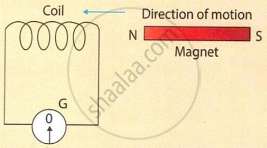
In the given figure, describe the deflection in the galvanometer
- when the magnet is kept stationary at its position;
- when the magnet is moved inside the coil and
- when the magnet is pulled out of the coil.
What is a step-up transformer?
Explain the characteristics of the primary and secondary coils of a step-up transformer.
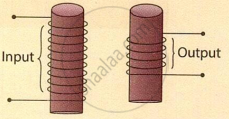
The given figure shows a transformer. State whether it is a step-up or step-down transformer. Give a reason for your answer.
Give two points of difference between a step-up transformer and step-down transformer.
How is the magnetic field due to a solenoid carrying current affected if a soft iron bar is introduced inside the solenoid?
Name and state the law which is used to determine the direction of force on a current carrying conductor placed in a magnetic field.
Draw a sketch and explain the experiment showing the magnetic lines of force due to a current-carrying straight conductor.
State and explain the clock-face rule for determining the polarities of a circular wire carrying current.
What is the function of the split rings in a d.c. motor?
When a current-carrying conductor is placed in a magnetic field, it experiences a mechanical force. What should be the angle between the magnetic field and the length of the conductor so that the force experienced is (i) zero and (ii) maximum?
State two advantages of an electromagnet over a permanent magnet.
Why does a current carrying freely suspended solenoid rest along a particular direction? State the direction in which it rests.
State two ways by which the magnetic field due to a current carrying solenoid can be made stronger.
Name the material used for making the armature of an electric bell. Give a reason for your answer.
Long Answer Questions
What is an electromagnet?
State the factors on which the strength of an electromagnet depends. How does it depend on these factors?
Write some of the important uses of electromagnets.
What is a solenoid?
Draw a sketch to show the magnetic field pattern produced by a currentcarrying solenoid.
Name the type of magnet with which the magnetic field pattern of a current-carrying solenoid resembles.
What is the shape of field lines inside a current-carrying solenoid? What does the pattern of field lines inside a current-carrying solenoid indicate?
List three ways in which the magnetic field strength of a current-carrying solenoid can be increased?
What type of core should be put inside a current-carrying solenoid to make an electromagnet?
Draw a labelled diagram of an electric motor. Explain its principle and parts.
State the law which is used to find the direction of magnetic field lines.
Write any two similarities between a current-carrying solenoid and a bar magnet.
Differentiate between the magnetic field due to a bar magnet and the magnetic field due to a current-carrying solenoid.
Explain the construction of an I-shaped electromagnet with the help of labelled diagram.
Explain the construction of a U-shaped electromagnet with the help of a labelled diagram.
Explain the principle and construction of an AC generator. Draw its diagram and clearly label the parts.
Explain the construction and working of an electric bell with a labelled diagram. Why is its armature made of soft iron and not steel?
What will be the effect of a straight current-carrying wire on the magnetic field if the current in the wire is increased?
Draw a diagram of a DC motor and label the following parts clearly.
- Armature
- Commutator
- Field magnet
- Brushes
Explain these parts briefly. What is the type of energy transfer involved in a DC motor?
The diagram below shows a magnetic needle kept just below the conductor AB which is kept in North South direction.
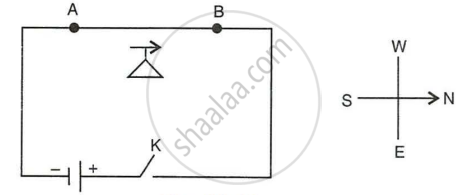
- In which direction will the needle deflect when the key _is closed?
- Why is the deflection produced?
- What will be the change in the deflection if the magnetic needle is taken just above the conductor AB?
- Name one device which works on this principle.
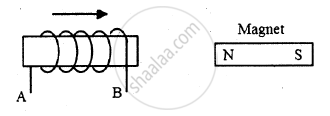
In the following diagram an arrow shows the motion of the coil towards the bar magnet.
(1) State in which direction the current flows, A to B or B to A?
(2) Name the law used to come to the conclusion.
The following diagram shows a current-carrying loop or a circular coil passing through a sheet of cardboard at the points M and N. The sheet of cardboard is sprinkled uniformly with iron filings.
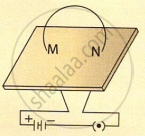
- Copy the diagram and draw an arrow on the circular coil to show the direction of current flowing through it.
- Draw the pattern of arrangement of the iron filings when current is passed through the loop.
(i) A straight wire conductor passes vertically through a piece of cardboard sprinkled with iron filings. Copy the diagram and show the setting of iron filings when a current is passed through the wire in the upward direction and the cardboard is tapped gently. Draw arrows to represent the direction of the magnetic field lines.
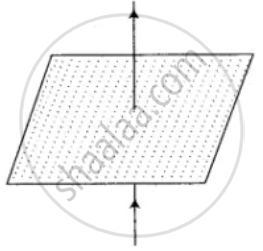
(ii) Name the law which helped you to find the direction of the magnetic field lines.
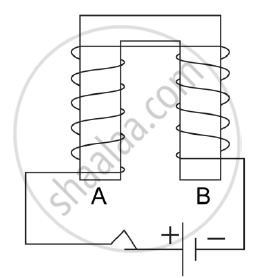
The diagram shows a coil wound around a U-shaped soft iron bar AB.
- What is the polarity induced at the ends A and B when the switch is pressed?
- Suggest one way to strengthen the magnetic field in the electromagnet.
- What will be the polarities at A and B if the direction of current is reversed in the circuit?
Numerical Problems
Calculate the primary voltage of a transformer with a turns ratio of 1 : 2 and a secondary voltage of 960 V.
An electric current of 2.0 A is flowing through a straight 0.10 m long wire that is perpendicular to a magnetic field. A force of 0.04 N is applied to the wire. What will be the magnetic field strength?
DO IT RIGHT
| Rajesh is a welder who was working at Mohan’s house. After making a ‘railing’ using electric welding with naked eyes, Rajesh was using a grinder on it to smoothen the welding joints. Just then some particles fell into Rajesh’s eye. He started crying with pain. Mohan hired an auto and took him to an eye hospital. In the hospital, the doctor used a device connected to two electric wires to remove the particle from Rajesh’s eye. Rajesh asked Mohan what had fallen into his eye and what device was used by the doctor to remove that particle from the eye. Being a science student of Class X, Mohan explained everything to Rajesh and asked him to be careful in future. |
- What could be the particle which fell into Rajesh’s eye?
- What device was used by the doctor to remove the particle and how it worked?
- What precautions should be observed by Rajesh while doing electric welding and grinding work?
- What values are shown by Mohan during this episode?
| Vaibhav had gone to his uncle’s home in a foreign country where the domestic electric supply is direct current (DC). An electrician was working in his uncle’s kitchen, who was trying to find out the location of electric wiring in a particular wall for further electrical work. Failing to do so, the electrician recommended the breaking of a substantial portion of the kitchen wall. Vaibhav told his uncle that he could locate the position of current-carrying wires in the kitchen wall without breaking the kitchen wall. In order to do this, Vaibhav purchased a small device from the market and moved it slowly over the whole kitchen wall. After about 10 minutes, Vaibhav could locate the position of all the current-carrying wires in this kitchen wall. His uncle was happy that now only a small portion of the kitchen wall will have to be dismantled. |
- What was the small device purchased by Vaibhav?
- What was noticed by Vaibhav when this device was moved slowly over the current-carrying wires embedded in the wall?
- What name was given to the effect which helped Vaibhav to locate the concealed current-carrying wires in the wall?
- Name the Scientist who discovered the above effect.
- What values are shown by Vaibhav in this episode?
Search on the Internet to learn more about the instrument known as a galvanometer. Who discovered this instrument? Find out if it is available in the school laboratory and understand its parts and working. Learn about the different types of galvanometers.
Create an electromagnetic train using a long coil made of copper wire, battery and neodymium magnets. First, wind the copper wire on a marker pen to create a coil. This coil acts as the track. Now, hold two magnets such that they push apart from each other. Now place the battery in between these magnets to attach the magnets to the ends of the battery. This battery magnet setup acts as the train. Now, arrange the coil on a flat surface without any sharp curves and place the train inside this coil track. Observe what happens to the train. The train will move inside the coil. How did that happen? Find out the principle behind this result.
Electromagnetic train
Solutions for 10: Electromagnetism
Lakhmir Singh solutions for Physics [English] Class 10 ICSE chapter 10 - Electromagnetism
Shaalaa.com has the CISCE Mathematics Physics [English] Class 10 ICSE CISCE solutions in a manner that help students grasp basic concepts better and faster. The detailed, step-by-step solutions will help you understand the concepts better and clarify any confusion. Lakhmir Singh solutions for Mathematics Physics [English] Class 10 ICSE CISCE 10 (Electromagnetism) include all questions with answers and detailed explanations. This will clear students' doubts about questions and improve their application skills while preparing for board exams.
Further, we at Shaalaa.com provide such solutions so students can prepare for written exams. Lakhmir Singh textbook solutions can be a core help for self-study and provide excellent self-help guidance for students.
Concepts covered in Physics [English] Class 10 ICSE chapter 10 Electromagnetism are .
Using Lakhmir Singh Physics [English] Class 10 ICSE solutions Electromagnetism exercise by students is an easy way to prepare for the exams, as they involve solutions arranged chapter-wise and also page-wise. The questions involved in Lakhmir Singh Solutions are essential questions that can be asked in the final exam. Maximum CISCE Physics [English] Class 10 ICSE students prefer Lakhmir Singh Textbook Solutions to score more in exams.
Get the free view of Chapter 10, Electromagnetism Physics [English] Class 10 ICSE additional questions for Mathematics Physics [English] Class 10 ICSE CISCE, and you can use Shaalaa.com to keep it handy for your exam preparation.
