Advertisements
Advertisements
Question
The device used for producing electric current is called a ______.
Options
generator
galvanometer
ammeter
motor
Advertisements
Solution
The device used for producing electric current is called a generator.
Explanation:
- A generator is a device that transforms mechanical energy into electrical energy.
- A galvanometer is a device that detects the existence of electricity in a circuit.
- An ammeter is a device that measures the amount of electric current flowing across a circuit.
- A motor is a piece of machinery that turns electrical energy into mechanical energy.
As a result, the generator is the correct solution.
RELATED QUESTIONS
State the principle of an electric generator.
Name some sources of direct current.
Which sources produce alternating current?
A rectangular coil of copper wires is rotated in a magnetic field. The direction of the induced current changes once in each______.
State whether the following statement is true or false.
An electric motor converts mechanical energy into electrical energy.
A coil of insulated copper wire is connected to a galvanometer. What will happen if a bar magnet is pushed into the coil?
Name the device which converts mechanical energy into electric energy.
Name the phenomenon which is made use of in an electric generator.
What type of generator is used at Power Stations?
What change should be made in an a.c. generator so that it may become a d.c. generator?
Each one of the following changes will increase emf (or voltage) in a simple generator except:
(a) increasing the number of turns in the armature coil
(b) winding the coil on a soft iron armature
(c) increasing the size of the gap in which the armature turns
(d) increasing the speed of rotation
An electric generator converts:
(a) electrical energy into mechanical energy.
(b) mechanical energy into heat energy.
(c) electrical energy into chemical energy.
(d) mechanical energy into electrical energy.
A d.c. generator is based on the principle of:
(a) electrochemical induction
(b) electromagnetic induction
(c) magnetic effect of current
(d) heating effect of current
Name and state the principle of a simple a.c. generator. What is its use?
In an a.c. generator the speed at which the coil rotates is doubled. How would this affect
- the frequency of output voltage,
- the maximum output voltage is doubled.
Explain the difference:
AC generator and DC generator.
Draw a neat labeled diagram of an A.C. generator
An a.c. generator changes the ______energy to ______ energy.
The given figures 1 to 3 show the working of a simple A.C. generator. Study the diagrams and answers of the following questions.
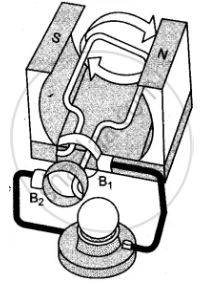
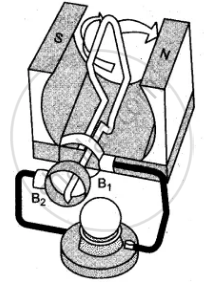
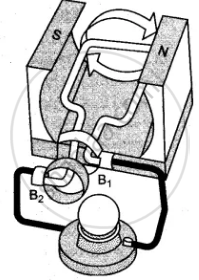
(i) State and explain the principle underlying the working of a simple generator.
(ii) Where is the loop of wire placed?
(iii) What happens when the loop is rotated?
(iv) Indicate the direction of the current flow through the wire for the first half of the turn (in first figure). Name and state the rule used in finding the direction of the current.
(v) Indicate the direction of the current for the case shown in second figure.
(vi) Indicate the direction of current in the outer circuit (i.e., electric bulb) in first and third figure.
(vii) What type of current is shown in the above diagrams? Explain.
A device for producing electric current is ______.
Draw and label the diagram of an AC generator.
Draw a neat diagram of an AC generator and explain its working.
A coil of insulated copper wire is connected to a galvanometer forming a loop and a magnet is:
A: Held stationary
B: Moved away along its axis
C: Moved towards along its axis
D: There will be an induced current in
To convert an AC generator into DC generator ____________.
A coil of insulated copper wire is connected to a galvanometer. What will happen if a bar magnet is withdrawn from inside the coil?
A coil of insulated copper wire is connected to a galvanometer. What will happen if a bar magnet is held stationary inside the coil?
An AC generator is provided with ______ slip rings that rotate with the coil.
State one factor that affects the magnitude of induced current in an AC generator.
