Advertisements
Advertisements
Question
The given figures 1 to 3 show the working of a simple A.C. generator. Study the diagrams and answers of the following questions.
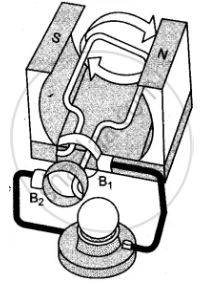
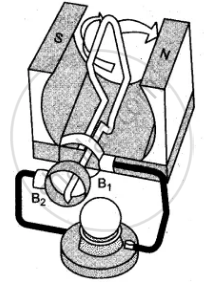
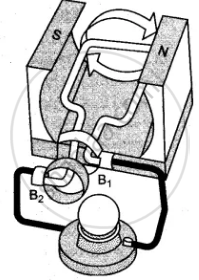
(i) State and explain the principle underlying the working of a simple generator.
(ii) Where is the loop of wire placed?
(iii) What happens when the loop is rotated?
(iv) Indicate the direction of the current flow through the wire for the first half of the turn (in first figure). Name and state the rule used in finding the direction of the current.
(v) Indicate the direction of the current for the case shown in second figure.
(vi) Indicate the direction of current in the outer circuit (i.e., electric bulb) in first and third figure.
(vii) What type of current is shown in the above diagrams? Explain.
Advertisements
Solution
(i) The generator works on the principle of Electromagnetic Induction. Whenever the flux passing through a closed circuit changes, e.m.f. is induced in it and a current begins to flow. Its direction is given by Fleming’s Right Hand Rule or Lenz Law. As long as the loop is moving within the magnetic field an electric current will flow.
(ii) The loop of wire is placed between the two poles of a ‘U’-shaped magnet.
(iii) When the loop of wire is rotated between the two poles of a ‘U’-shaped magnet an electric current flows through the wire.
(iv) As rotation of the coil is the clockwise direction and the direction of magnetic field is from right to left, the current will flow in the anticlockwise direction, i.e., from B2 and B1. The law used is Lenz’s law.
Lenz’s law: “The direction of the induced e.m.f. is such that it opposes the change responsible for its production.”
(v) No electric current flows when the loop of wire is halfway through the turn, i.e., at an angle of 90° [as sin 90° = 0.]
(vi) First figure: From brush B2 to B1
Third figure: From brush B1 to B2
(vii) The type of current shown is an alternating current or A.C. current. When the loop of wire makes the second half of the turn (fig., the direction of the electric current through the bulb is reversed and it flows back in the opposite direction.
RELATED QUESTIONS
Explain the underlying principle and working of an electric generator by drawing a labelled diagram. What is the function of brushes?
Name the phenomenon which is made use of in an electric generator.
Why are Thermal Power Stations usually located near a river?
Each one of the following changes will increase emf (or voltage) in a simple generator except:
(a) increasing the number of turns in the armature coil
(b) winding the coil on a soft iron armature
(c) increasing the size of the gap in which the armature turns
(d) increasing the speed of rotation
Name and state the principle of a simple a.c. generator. What is its use?
Draw a labelled diagram of a simple a.c. generator.
State one advantage of using a.c. over d.c.
Draw a neat diagram of an AC generator and explain its working.
A coil of insulated copper wire is connected to a galvanometer forming a loop and a magnet is:
A: Held stationary
B: Moved away along its axis
C: Moved towards along its axis
D: There will be an induced current in
A coil of insulated copper wire is connected to a galvanometer. What will happen if a bar magnet is withdrawn from inside the coil?
