Advertisements
Advertisements
Question
Observe the figure and write the answers to the questions asked.
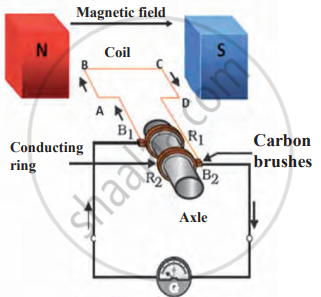
- The construction shown in the figure is of which device?
- Explain the principle on which this device works.
- Write any three uses of this device.
Advertisements
Solution
- The figure shows the construction of an electric generator.
- Principle of electric generator: Electric generator works on the principle of electromagnetic induction. When the coil of the electric generator rotates in a magnetic field, the magnetic field induces a current in this coil. This induced current then flows into the circuit connected to the coil.
- Uses of electric generator are-
- Providing backup energy for emergencies.
- Powering construction sites.
- Powering nuclear reactor plants.
- Providing backup for hospitals and other office buildings
APPEARS IN
RELATED QUESTIONS
The essential difference between an AC generator and a DC generator is that
Explain the underlying principle and working of an electric generator by drawing a labelled diagram. What is the function of brushes?
Name the device which converts mechanical energy into electric energy.
Name the phenomenon which is made use of in an electric generator.
Why are Thermal Power Stations usually located near a river?
State two ways in the which the current alternating current and direct current?
A d.c. generator is based on the principle of:
(a) electrochemical induction
(b) electromagnetic induction
(c) magnetic effect of current
(d) heating effect of current
The frequency of alternating current (a.c.) supply in India is ______.
State whether the following statement are true of false:
A miniature circuit breaker (MCB) works on the heating effect of current.
The current induced in a closed circuit only if there is ______.
What energy conversion does take place in a generator when it is in use?
Explain the difference:
AC generator and DC generator.
Explain the construction and working of an electric generator (AC) with the help of a neat diagram.
Draw a neat diagram of an AC generator and explain its working.
A coil of insulated copper wire is connected to a galvanometer forming a loop and a magnet is:
A: Held stationary
B: Moved away along its axis
C: Moved towards along its axis
D: There will be an induced current in
A coil of insulated copper wire is connected to a galvanometer. What will happen if a bar magnet is withdrawn from inside the coil?
An AC generator is provided with ______ slip rings that rotate with the coil.
Observe the following diagram and answer the questions.

- Explain the construction of the equipment shown in the figure.
- How is AC generated?
