Advertisements
Advertisements
प्रश्न
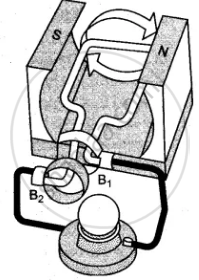
Observe the figure and write the answers to the questions asked.
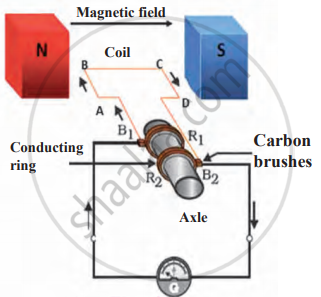
- The construction shown in the figure is of which device?
- Explain the principle on which this device works.
- Write any three uses of this device.
Advertisements
उत्तर
- The figure shows the construction of an electric generator.
- Principle of electric generator: Electric generator works on the principle of electromagnetic induction. When the coil of the electric generator rotates in a magnetic field, the magnetic field induces a current in this coil. This induced current then flows into the circuit connected to the coil.
- Uses of electric generator are-
- Providing backup energy for emergencies.
- Powering construction sites.
- Powering nuclear reactor plants.
- Providing backup for hospitals and other office buildings
APPEARS IN
संबंधित प्रश्न
Why are Thermal Power Stations usually located near a river?
Complete the following sentence:
A generator with commutator produces ............... current.
Each one of the following changes will increase emf (or voltage) in a simple generator except:
(a) increasing the number of turns in the armature coil
(b) winding the coil on a soft iron armature
(c) increasing the size of the gap in which the armature turns
(d) increasing the speed of rotation
Draw a labelled diagram of a simple a.c. generator.
Observe the figure and answer the following questions.
a) Identify the machine shown in figure.
b) Write a use of this machine.
c) How transformation of energy takes place in this machine.
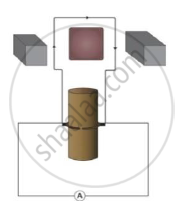
An a.c. generator changes the ______energy to ______ energy.
State change that you would make to convert an A.C. generator into a D.C. generator. Illustrate the change by a diagram.
The given figures 1 to 3 show the working of a simple A.C. generator. Study the diagrams and answers of the following questions.
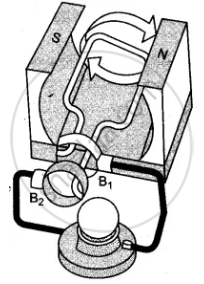
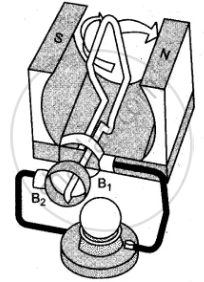
(i) State and explain the principle underlying the working of a simple generator.
(ii) Where is the loop of wire placed?
(iii) What happens when the loop is rotated?
(iv) Indicate the direction of the current flow through the wire for the first half of the turn (in first figure). Name and state the rule used in finding the direction of the current.
(v) Indicate the direction of the current for the case shown in second figure.
(vi) Indicate the direction of current in the outer circuit (i.e., electric bulb) in first and third figure.
(vii) What type of current is shown in the above diagrams? Explain.
State true or false:
The frequency of AC is 50 Hz.
A device for producing electric current is ______.
Draw and label the diagram of an AC generator.
Draw a neat diagram of an AC generator and explain its working.
A coil of insulated copper wire is connected to a galvanometer. What will happen if a bar magnet is withdrawn from inside the coil?
An AC generator is provided with ______ slip rings that rotate with the coil.
In what direction are the magnetic field arrows drawn between the poles?
What is the angle between the area vector \[A\] of the coil and the magnetic field \[B\] at time \[t\]?
What type of current flows in the external load?
What is the area of the stationary-bicycle generator's coil?
What voltage range is given as an example for generators in real power stations?
