Advertisements
Online Mock Tests
Chapters
![Lakhmir Singh solutions for Physics [English] Class 10 ICSE chapter 8 - Current Electricity - Shaalaa.com](/images/physics-english-class-10-icse_6:bfbcc704031b4fd398b72f80ee978e3f.jpg "Lakhmir Singh solutions for Physics [English] Class 10 ICSE chapter 8 - Current Electricity")
Advertisements
Solutions for Chapter 8: Current Electricity
Below listed, you can find solutions for Chapter 8 of CISCE Lakhmir Singh for Physics [English] Class 10 ICSE.
Lakhmir Singh solutions for Physics [English] Class 10 ICSE 8 Current Electricity Intex Question [Pages 181 - 203]
THINK AND ANSWER
How do tyres on a car shield you from lightning strikes?
THINK AND ANSWER
Why is a 12-V domestic battery safe, but an electric shock from a 12-V automobile battery can be fatal?
TEST YOUR UNDERSTANDING - 1
State Ohm’s law.
Explain with diagrams the series and parallel combination of resistances.
The value of equivalent resistance will be maximum in which combination?
A high-resistance voltmeter measures the potential difference across a battery as 9 V. On connecting a 24 Ω resistor across the terminals of the battery, the reading of the voltmeter is 7.2 V. Calculate the internal resistance of the battery.
State two differences between the e.m.f. and terminal voltage of a cell.
If 550 μA is flowing through 10 kΩ of resistance, what is the voltage drop across the resistor?
What is the maximum resistance which can be made using four 0.5 resistances?
State whether the following statement is true or false.
The direction of flow of electrons in the electric circuit is the same as that of electric current flow.
State whether the following statement is true or false.
The emf is the terminal potential difference when there is no current flow in an electric circuit.
Fill in the following blanks with suitable words.
The resistance is measured in ______.
The electric current is ______ proportional to voltage.
Choose the correct option for each of the following questions.
Resistance R is equal to ______.
`V/I`
I + V
I × V
`I/V`
If 10 resistors each of resistance R are connected in parallel combination, then their equivalent resistance is ______.
`R/100`
`R/10`
`10/R`
`R/100`
Two devices are connected between two points say A and B in parallel. The physical quantity that will remain the same between the two points is:
current
voltage
resistance
None of these
THINK AND ANSWER
Is it possible for electronic devices to charge themselves without being hooked onto a power supply?
TEST YOUR UNDERSTANDING - 2
State two factors on which the electrical energy consumed by an electrical appliance depends.
If the potential difference between the end of a wire of fixed resistance is doubled, by how much does the electric power increase?
Define Electric power.
What is the SI unit of electric power?
State the differences between electric power and electrical energy.
Define kilowatt-hour.
How many joules are there in one kilowatt-hour?
Define electrical energy.
State the S.I. unit of energy.
Calculate the number of units of electricity used if a bulb of 18 W is kept on for 9 hours.
Calculate the cost of operating a heater of 500 W for 20 hours at the rate of Rs 3.90 per unit.
State whether the following statement is true or false.
A body is stated to have an electric power of 1 W if it does work at the rate of 1 J in 1 min.
State whether the following statement is true or false.
The commercial unit of electrical energy is kilojoule.
Fill in the following blanks with suitable words.
One watt equals one joule per ______.
An electric bulb of 100 W transfers ______ J of energy in 1 minute.
Choose the correct option for each of the following questions.
Electric power is directly proportional to the square of ______.
potential difference
electric current
resistance
none of these
An electric car generates 100 V. The resistance offered is 50 Ω. Calculate the power generated by the car.
2000 W
20 W
200 W
220 W
Lakhmir Singh solutions for Physics [English] Class 10 ICSE 8 Current Electricity EXERCISE [Pages 206 - 211]
Objective Questions
True or False.
There is only one path for electric current to flow in a series circuit.
True or False.
A voltmeter is connected in series only.
True or False.
An ammeter is used to measure electric current in series circuits only.
True or False.
When the resistors in a circuit are linked in parallel rather than series, the equivalent resistance is low.
True or False.
Potential difference is the difference between the voltage of two cells.
Fill in the Blanks
The V-I graph for ohmic resistors is a ______.
The value of fundamental charge is ______ C.
The ______ combination of resistors has the least resistance.
The commercial unit of power is ______.
Our household circuit is connected in ______ combination.
Multiple Choice Questions
A material of resistivity (ρ) is used to make a wire of length (l). If this wire is divided into two equal pieces, the resistivity of the two pieces is equivalent to:
ρ
`ρ/2`
2ρ
4ρ
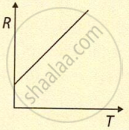
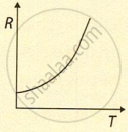
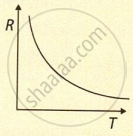
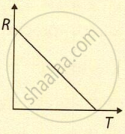
Which of the following depicts the change in resistance when the temperature of the conductor is increased?
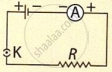
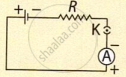
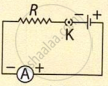
A cell, a resistor, a key and an ammeter are arranged as shown in the given circuit diagrams. Based on these diagrams, choose the correct option.
 |
 |
 |
| (i) | (ii) | (iii) |
The ammeter will show greater current in the circuit (ii).
The ammeter will show greater current in the circuit (iii).
The ammeter will show greater current in the circuit (i).
The ammeter will show equal flow of current in all three circuits.
Find the equivalent resistance between A and B of the given circuit.
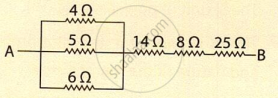
62.5 Ω
48.62 Ω
32.5 Ω
30 Ω
The work done in moving a unit charge across two points in an electric circuit is a measure of ______.
current
potential difference
resistance
power
One watt equals to ______.
one kilojoule per second
one kilojoule per second
one joule per second
one joule per minute
What happens to the electric current across each resistor when resistors are connected in series?
Increases
Reduces
Stays steady
Increases at first, and then declines
Two identically built wires have the same length, but their radii are arranged in a 5 : 3 ratio. The resistance of the thicker wire, which is connected in series, is 12 Ω. Identify the total resistance of the combination.
12 Ω
19 Ω
30 Ω
32 Ω
A car headlight bulb working on a 12 V car battery draws a current of 0.5 A. The resistance of the light bulb is:
0.5 Ω
6 Ω
12 Ω
24 Ω
Which of the following does not affect the internal resistance of a cell?
Distance between the electrodes
Temperature of the electrolyte
Composition of electrode and electrolyte
Area of the electrodes submerged in electrolyte
Match the items of Column I with that of Column II and choose the appropriate code.
| Column I | Column II |
| A. Electrical energy | (i) V |
| B. Electric current | (ii) A |
| C. Potential difference | (iii) kW h |
| D. Electric power | (iv) W |
A - (iii), B - (ii), C - (i), D - (iv)
A - (i), B - (iii), C - (ii), D - (iv)
A - (iv), B - (i), C - (ii), D - (iii)
A - (iii), B - (i), C - (ii), D - (iv)
DescriptiveQuestions Short Answer Questions
Name any three substances whose resistivity decreases with the increase in temperature.
Give two differences between an ohmic and non-ohmic resistor.
Define Electric potential.
State the S.I. unit of electric potential.
Define the term potential difference.
Write SI unit of
Potential difference
Name three factors on which resistance of a given wire depends and state how is it affected by the factors stated by you.
How does the temperature affect the resistance of semiconductors?
What happens to the resistance of a conductor as the voltage applied across it increases?
State the name of any material which is used to make a standard resistor.
Explain the effect of electric current in the generation of heat in an electric heater.
Explain the effect of temperature on the resistance in a conductor.
Define 1 watt of power.
Write the three units of power.
Write an expression for the electrical energy spent in flow of current through an electrical appliance in terms of current, resistance and time.
Explain the meaning of the statement ‘the power of an appliance is 100 W’.
What is the meaning of the symbol kWh? Which quantity does it represent?
What is the voltage of the electricity that is generally supplied to a house?
Define the term resistivity.
Give SI unit of resistivity.
Name two factors on which the resistivity of a substance depends.
Name two factors on which the resistivity of a substance does not depend.
Define the following:
Electromotive force
State two differences between the e.m.f. and terminal voltage of a cell.
Name a substance whose specific resistance essentially does not change as the temperature rises.
Below 1 K, a substance exhibits no resistance at all. What is the name of such a substance?
Define the terminal voltage of a cell.
State the relationship between emf and terminal voltage of a cell.
What is Ohm's law? Explain how it is used to define the unit of resistance.
What is consumed using different electrical appliances, for which electricity bills are paid?
Explain the factors that affect the heat generated in a current-carrying conductor. Derive its formula.
Long Answer Questions
Write the factors that can affect the flow of electric current.
State the effect of the following on the resistance of a conductor.
The length of the conductor is increased by 2 times.
State the effect of the following on the resistance of a conductor.
The area of the conductor is decreased by 4 times.
State the effect of the following on the resistance of a conductor.
The resistivity is increased by 3 times.
State the effect of the following on the resistance of a conductor.
The temperature is increased.
Distinguish between the resistivity and conductivity of a conductor.
Provide a comparison between the following:
Resistance and conductance
Draw V–I graph for ohmic resistors.
Draw V–I graph for non-ohmic resistors.
Define internal resistance of a cell.
Derive the relation for the internal resistance of a cell.
On what factors does the internal resistance of a cell depend?
What is electric energy?
Derive the equation for electric power.
State why some common household appliances use high-resistance conductors while some use low-resistance conductors.
Show by a diagram how two resistors R1 and R2 are joined in parallel. Obtain an expression for the total resistance of the combination.
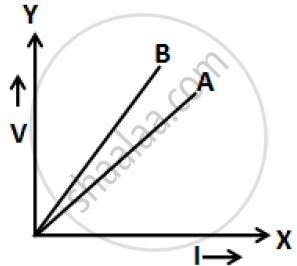
The V-I graph for a series combination and for a parallel combination of two resistors is shown in the figure below. Which of the two A or B. represents the parallel combination? Give reasons for your answer.
List the names of three electrical gadgets used in your house. Write their power, voltage rating and approximate time for which each one is used in a day. Hence, find the electrical energy consumed by each in a day.
Two bulbs rated at 240 V-60 W and 240 V-100 W are linked in series to a 240 V mains supply. Why does the 60 W lamp use more electric power? Explain.
Numerical Problems
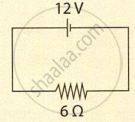
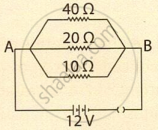
How much of electric current flows through the given circuit?
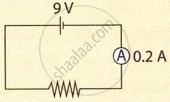
Calculate the value of the resistor in the given circuit.
A boy finds out that a resistor with a resistance of 50 Ω requires 5000 J of work to transfer 10 C of electric charge between two points. Calculate the flow of current through the resistor.
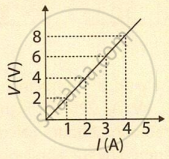
Calculate the value of resistance from the given V-I graph.
Determine the electric current that passes through the 20 Ω resistor in the given circuit.
A series connection of two resistors results in an equivalent resistance of 20 Ω. When they are connected in parallel, the effective resistance is 4.8 Ω. Calculate the value of individual resistances.
A 10-V battery can deliver 2 × 10⁻³ C of charge through a 20 resistance. What will be the amount of work done in 10 s?
A current of 1 A is drawn by a filament of an electric bulb. What would be the number of electrons passing through the cross-section of the filament in 16 s?
What is the resistance of a 240 V, 60 W electric bulb under typical operating conditions? If two such bulbs are connected in series over a 240 V mains supply, why does one bulb appear to be less bright than the other?
Two coils of resistances, R1 = 3 Ω and R2 = 6 Ω, are connected in series to a battery of pd 12 V. Draw a circuit diagram and determine the total electrical energy supplied by the battery in 1 min.
Calculate the equivalent resistance between A and B in the given circuit diagram.
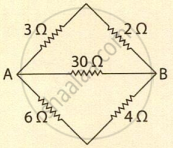
Calculate the equivalent resistance between points A and B in the given circuit diagram.
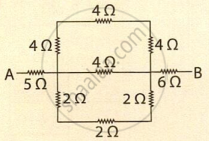
Calculate the equivalent resistance of the given circuit diagram.
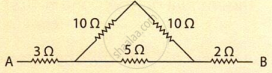
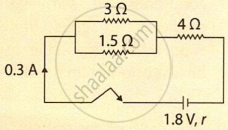
Three resistors are connected across a cell with an internal resistance of r and an emf of 1.8 V in the given circuit diagram. Determine the internal resistance r and the current flowing through the three resistors.
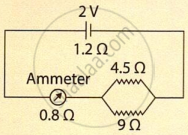
As illustrated in the given circuit diagram, an ammeter with a resistance of 0.8 and two resistors of 4.5 Ω and 9 Ω are connected to a cell with an emf of 2 V and internal resistance of 1.2 Ω. Determine the ammeter reading and the potential difference between the terminals of the cell.
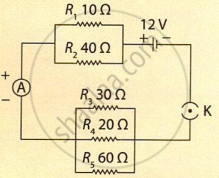
In the given circuit diagram, calculate the net resistance of the circuit, and hence, find the net flow of electric current.
Three resistors are connected to a 6 V battery as shown in the figure given below:
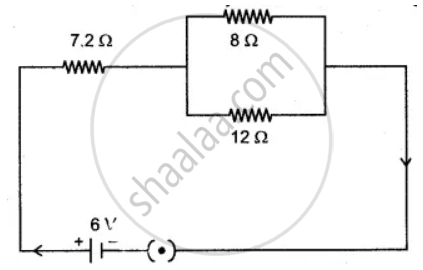
Calculate:
(i) the equivalent resistance of the circuit.
(ii) total current in the circuit.
(iii) potential difference across the 7.2 Ω resistor.
Find the equivalent resistance between points A and B
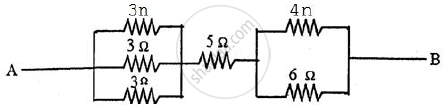
An electrical appliance is rated at 1000 KVA, 220V. If the appliance is operated for 2 hours, calculate the energy consumed by the appliance in: (i) kWh (ii) joule.
Calculate the quantity of heat that will be produced in a coil of resistance 75 Ω if a current of 2A is passed through it for 2 minutes.
DO IT RIGHT
| Rahul went to an electronics shop to get his father’s old radio set repaired. The radio mechanic required resistances of 1.5 Ω and 10 Ω to repair the radio set properly but he had only a large number of 3 Ω resistors. The radio mechanic made many attempts but could not get the right combinations of 3 resistors to obtain 1.5 Ω and 10 Ω resistances. Rahul had studied the combination of resistors in Class X. Rahul thought for a while and then joined some 3 Ω resistors in two different ways to obtain the required resistances. |
- How did Rahul obtain 1.5 Ω resistance by joining a number of 3 Ω resistors?
- How many 3 Ω resistors were combined together to obtain 1.5 Ω resistance?
- How did Rahul obtain 10 Ω resistance by joining a number of 3 Ω resistors?
- How many 3 Ω resistors were combined together by Rahul to obtain 10 Ω resistance?
- What values are shown by Rahul in this episode?
Have you seen an electricity meter in your home? Note down the readings on the electricity meter for two consecutive days at the same time, say Sunday 8 AM and Monday 8 AM. Now, answer the following:
- What was the meter reading on the first day (Sunday)?
- What was the meter reading on the second day (Monday)?
- How many units of electricity have been used?
- In how much time have these units been used?
- If the rate is ₹ 5 per unit, what is the cost of electricity used during this time?
- How can we reduce energy consumption?
Solutions for 8: Current Electricity
Lakhmir Singh solutions for Physics [English] Class 10 ICSE chapter 8 - Current Electricity
Shaalaa.com has the CISCE Mathematics Physics [English] Class 10 ICSE CISCE solutions in a manner that help students grasp basic concepts better and faster. The detailed, step-by-step solutions will help you understand the concepts better and clarify any confusion. Lakhmir Singh solutions for Mathematics Physics [English] Class 10 ICSE CISCE 8 (Current Electricity) include all questions with answers and detailed explanations. This will clear students' doubts about questions and improve their application skills while preparing for board exams.
Further, we at Shaalaa.com provide such solutions so students can prepare for written exams. Lakhmir Singh textbook solutions can be a core help for self-study and provide excellent self-help guidance for students.
Concepts covered in Physics [English] Class 10 ICSE chapter 8 Current Electricity are .
Using Lakhmir Singh Physics [English] Class 10 ICSE solutions Current Electricity exercise by students is an easy way to prepare for the exams, as they involve solutions arranged chapter-wise and also page-wise. The questions involved in Lakhmir Singh Solutions are essential questions that can be asked in the final exam. Maximum CISCE Physics [English] Class 10 ICSE students prefer Lakhmir Singh Textbook Solutions to score more in exams.
Get the free view of Chapter 8, Current Electricity Physics [English] Class 10 ICSE additional questions for Mathematics Physics [English] Class 10 ICSE CISCE, and you can use Shaalaa.com to keep it handy for your exam preparation.
