Advertisements
Advertisements
Question
Define Electric power.
Advertisements
Solution
Electric power (P) is the rate at which electrical energy is transferred or consumed in an electrical circuit.
APPEARS IN
RELATED QUESTIONS
Which uses more energy, a 250 W TV set in 1 hr, or a 1200 W toaster in 10 minutes?
If a bulb of 60W is connected across a source of 220V, find the current drawn by it.
Define watt. Write down an equation linking watts, volts and amperes.
A 2 kWh heater, a 200 W TV and three 100 W lamps are all switched on from 6 p.m. to 10 p.m. What is the total cost at Rs 5.50 per kWh?
What is meant by "electric power"?
The diagram below shows a circuit containing a lamp L, a voltmeter and an ammeter,. The voltmeter reading 3 V and the ammeter reading is 0.5 A.
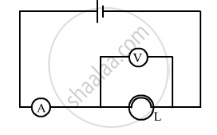
What is the resistance of the lamp?
What is the power of the lamp?
An electric kettle for use on a 230 V supply is rated 3000 W. For safe working, the cable connected to it should be able to carry at least:
(a) 2 A
(b) 5 A
(c) 10 A
(d) 15 A
Which of the following is the most likely temperature of the filament of an electric light bulb when it is working on the normal 220 V supply line?
(a) 500°C
(b) 1500°C
(c) 2500°C
(d) 4500°C
Electrical power p is given by the expression P = (Q × V) ÷ time. Express the power P in terms of current and resistance explaining the meaning of symbols used there in.
An electric iron is rated at 750 W, 230 V. Calculate the electrical energy consumed by the iron in 16 hours .
Two bulbs are rated 60 W, 220 V and 60 W, 110 V respectively. Calculate the ratio of their
resistances
An electric toaster draws 8 A current in a 220 V circuit. It is used for 2 h. Find the cost of
operating the toaster if the cost of electrical energy is Rs. 4.50 per kWh.
The coil of an electric bulb takes 40 watts to start glowing. If more than 40 W are supplied, 60% of the extra power is converted into light and the remaining into heat. The bulb consumes 100 W at 220 V. Find the percentage drop in the light intensity at a point if the supply voltage changes from 220 V to 200 V.
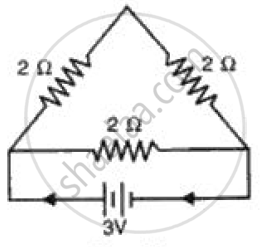
What is the current I in the given circuit (Fig. )?
State the S.I. units of electrical power and electrical energy.
(i) Define the household unit of electricity.
(ii) What is the voltage of the electricity that is generally supplied to a house?
Why is heating element wound on a long porcelain rod in a room heater.
How does the heat produced by die passage of current in a metallic wire depend on the current in the wire?
At what voltage is the electric power generated at the generating station? Explain the transmission of this power to your house.
How is the amount of heat produced calculated due to the passage of current in a metallic conductor? Derive an expression for it.
Three 250 W heaters are connected in parallel to a 100 V supply, Calculate the energy supply in kWh to the three heaters in 5 hour.
An electric lamp A of 40 W and another electric lamp B of 100 W are connected to 220 V supply. Calculate the ratio of their filament resistances?
Out of the three fuses with current ratings 5A, 10A, 15A, which one is to be connected in a geyser circuit marked 3 kW, 220V? Give reason for your answer.
A house is provided with 15 bulbs of 40W, 5 bulbs of 100W, 5 fans of 80 W, and one heater of 1.0 kW. Each day bulbs are used for 4h, fans for lOh, and heater for 2h. The voltage of mains is 220 V. Calculate:
(i) Maximum power of the circuit in the house,
(ii) maximum current capacity of the main fuse in the house,
(iii) the electrical energy consumed in a week,
(iv) cost of electricity consumed at 1.25 Rs. per kWh.
A torch bulb is rated at 3 V and 600 mA. Calculate it’s
- power
- resistance
- energy consumed if it is used for 4 hours.
What is the commercial unit of electrical energy?
What is the commercial unit of electrical energy? Represent it in terms of joules.
