Advertisements
Advertisements
Question
A family uses a light bulb of 100W, a fan of 100W, and a heater of 1000W, each for 8 hours a day. If the cost of electricity is Rs. 2 per unit, what is the expenditure to the family per day, on electricity?
Advertisements
Solution
Power consumed in watt-hours
= 100 × 8 + 100 × 8 + 1000 × 8
(bulb) (fan) (heater)
= (800 + 800 + 8000) watt-hours
= 9600 watt hour (units)
i.e. Electric energy comsumed in kWh (units)
`= 9600/1000 = 9.6` kWh.
Cost at Rs. 2 per unit or per kWh
= Rs. 2 × 9.6 = Rs. 19.20.
RELATED QUESTIONS
An electric bulb is rated at 220 V, 100 W. What is its resistance?
Name the quantity whose unit is kilowatt?
The commercial unit of energy is :
(a) watt
(b) watt-hour
(c) kilowatt-hour
(d) kilo-joule
Electrical power P is given by the expression P = (Q × V) ÷ time. What do the symbols Q and V represent?
Electrical power p is given by the expression P = (Q × V) ÷ time. Express the power P in terms of current and resistance explaining the meaning of symbols used there in.
An electric iron is rated at 750 W, 230 V. Calculate the electrical energy consumed by the iron in 16 hours .
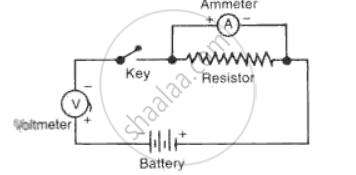
What is wrong with the circuit diagram (Fig. 34)? Carefully check the symbols and assign proper positive and negative signs to them.
An electric bulb is rated as 100W – 250V. What information does it convey? Calculate the current through the filament of the bulb.
The average work done by a human heart while it beats once is 0.5 Joule. The power used by heart if it beats 72 times in a minute:
