Advertisements
Advertisements
Question
An electric bulb is rated 250 W, 230 V. Calculate:
- the energy consumed in one hour
- the time in which the bulb will consume 1.0 kWh energy when connected to 230 V mains.
Advertisements
Solution
Power P = 250 W,
t = 1 hr = 3600 S
- ∴ Energy consumed W = P × t
= 250 × 3600
= 900000 J
W = 9 × 10⁵ J - 1.0 kWh = 36 × 105 J
∴ t in hours = `(36 xx 10^5)/(9 xx 10^5)`
= 4 hours
APPEARS IN
RELATED QUESTIONS
When an electric lamp is connected to 12 V battery, it draws a current of 0.5 A. The power of the lamp is:
(a) 0.5 W
(b) 6 W
(c) 12 W
(d) 24 W
How many joules of electrical energy are transferred per second by a 6 V; 0.5 A lamp?
(a) 30 J/s
(b) 12 J/s
(c) 0.83 J/s
(d) 3 J/s
At a given time, a house is supplied with 100 A at 220 V. How many 75 W, 220 V light bulb could be switched on in the house at the same time (if they are all connected in parallel)?
Name the S.I. unit of electrical energy. How is it related to Wh?
What is the resistance, under normal working conditions of a 240 V electric lamp rated at 60 W? If two such lamps are connected in series across a 240 V mains supply, explain why each one appears less bright.
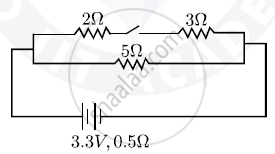
The diagram above shows a circuit with the key k open. Calculate :
(i) the resistance of the circuit when the key k is open.
(ii) the current drawn from the cell when the key k is open.
(iii) the resistance of the circuit when the key k is closed.
(iv) the current drawn from the cell when the key k is closed.
What would happen and why, to an electric bulb when it is connected across a supply of voltage (i) lower (ii) higher than its proper rating?
Electric power is inversely proportional to ____________.
A conductor of 10 Ω is connected across a 6 V ideal source. The power supplied by the source to the conductor is ______.
