Advertisements
Advertisements
Question
What would happen and why, to an electric bulb when it is connected across a supply of voltage (i) lower (ii) higher than its proper rating?
Advertisements
Solution
We know, Current = Voltage/Resistance
For a given bulb, the filament would have a definite characteristic resistance. Hence
(i) When the bulb is connected to a lower voltage supply, it would draw less current than its ‘proper current’. Hence it would not glow to its full capacity.
(ii) When the bulb is connected to a higher voltage supply, it would draw more current than its ‘proper current’. Hence its filament would get heated to a temperature higher than its proper permitted limit and is, therefore, likely to melt or fuse.
RELATED QUESTIONS
An electric kettle connected to the 230 V mains supply draws a current of 10 A. Calculate:
(a) the power of the kettle.
(b) the energy transferred in 1 minute.
A 2 kWh heater, a 200 W TV and three 100 W lamps are all switched on from 6 p.m. to 10 p.m. What is the total cost at Rs 5.50 per kWh?
The unit for expressing electric power is:
(a) volt
(b) joule
(c) coulomb
(d) watt
At a given time, a house is supplied with 100 A at 220 V. How many 75 W, 220 V light bulb could be switched on in the house at the same time (if they are all connected in parallel)?
An electrical appliance having a resistance of 200Ω is operated at 200 V. Calculate the energy consumed by the appliance in 5 minutes (i) in joules (ii) in kWh.
Two bulbs are rated 60 W, 220 V and 60 W, 110 V respectively. Calculate the ratio of their
resistances
The diagram below shows a magnetic kept just below the conductor AB which is kept in North South direction.
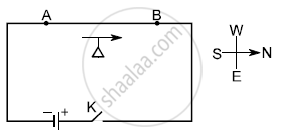
(i) In which direction will the needle deflect when the key is closed ?
(ii) Why is the deflection produced ?
(iii) What will be the change in the deflection if the magnetic needle is taken just above the conductor AB ?
(iv) Name one device which works on this principle.
How does the heat produced by die passage of current in a metallic wire depend on the time of passage of current in the wire?
State (i) the S. I. unit, (ii) the household unit, of electrical energy. How are these units related?
