Advertisements
Advertisements
प्रश्न
What would happen and why, to an electric bulb when it is connected across a supply of voltage (i) lower (ii) higher than its proper rating?
Advertisements
उत्तर
We know, Current = Voltage/Resistance
For a given bulb, the filament would have a definite characteristic resistance. Hence
(i) When the bulb is connected to a lower voltage supply, it would draw less current than its ‘proper current’. Hence it would not glow to its full capacity.
(ii) When the bulb is connected to a higher voltage supply, it would draw more current than its ‘proper current’. Hence its filament would get heated to a temperature higher than its proper permitted limit and is, therefore, likely to melt or fuse.
संबंधित प्रश्न
An electric kettle for use on a 230 V supply is rated 3000 W. For safe working, the cable connected to it should be able to carry at least:
(a) 2 A
(b) 5 A
(c) 10 A
(d) 15 A
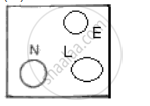
The diagram 31 shows a 3 terminal plug socket.
(i) What is the purpose of the terminal E?
(ii) To which part of the appliance is the terminal E connected?
(iii) To which wire L or N, is the fuse connected and why?
Express watt hour and kilowatt hour in joule.
Point out two main disadvantages of ‘Tree System’.
Why is a concave reflector placed behind the heating element in a room heater.
Three 250 W heaters are connected in parallel to a 100 V supply, Calculate the resistance of each heater.
State other bigger units of electric power and express them in watt.
I ampere of current is passed through a resistor of resistance R ohm for time t second. Obtain expression for
(i) the electrical energy, and
(ii) the electrical power spent.
Two resistances R1 = 4Ω and R2 = 6Ω are connected in series. The combination is connected with a battery of e.m.f. 6V and negligible resistance. Calculate:
(i) the heat produced per minute in each resistor,
(ii) the power supplied by the battery.
The average work done by a human heart while it beats once is 0.5 Joule. The power used by heart if it beats 72 times in a minute:
