Advertisements
Advertisements
Question
Two bulbs are rated 60 W, 220 V and 60 W, 110 V respectively. Calculate the ratio of their resistances.
Advertisements
Solution
Given,
Voltage, V1 = 220 V
V2 = 110 V
Power, P1 = P2 = P = 60 W
As R = `"V"^2/"P"`
`"R"_1 = "V"_1^2/"P" = (220 xx 220)/60`
`"R"_2 = "V"_2^2/"P" = (110 xx 110)/60`
On dividing R1 and R2
`"R"_1/"R"_2 = ((220 xx 220)/60)/((110 xx 110)/60)`
= `4/1`
`"R"_1 : "R"_2 = 4 : 1`
APPEARS IN
RELATED QUESTIONS
S.I. unit and commercial unit of electrical energy are same.
The unit in which we pay the cost of electricity is ..........
The purpose of an electric meter in a house is
State the purpose of kWh meter.
One day the meter reading is found to be 7643 units while the next day, it was 7657 units. What is the consumption of electricity in a day?
If an appliance of power P watt is used for time t hour. How much electrical energy is consumed in kWh?
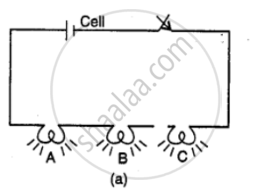
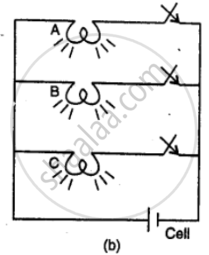
Figure shows two ways of connecting the three bulbs A, B and C to a battery. Name the two arrangements. Which of them do you prefer to use in a household circuit? Give a reason to support your answer.
An electric iron of power 1.5 kW is used for 30 minutes to press the clothes. Calculate the electrical energy consumed in
- kilowatt-hour
- joule.
In a premise 5 bulbs each of 100 W, 2 fans each of 60 W, 2 A.Cs each of 1.5 kW is used for 5 h per day. Find:
- Total power consumed per day,
- Total power consumed in 30 days,
- Total electrical energy consumed in 30 days.
- The cost of electricity at the rate of ₹ 6.25 per unit.
Our body can pass electricity through it.
