Advertisements
Advertisements
Question
Advertisements
Solution
Case (i) Energy consumed by two bulbs per day
= 2 x `60 /1000` x 4= 0.48 kWh
Case (ii) Energy consumed by three bulbs per day
= 3 x `100/1000` x 5 = 1. 5 kWh
:. total energy consumed per day = 0.48 + 1.5 = 1.98 kWh
Required consumption of electrical during the month of June (30 days)=
= 1.98 x 30 = 59.4 kWh
APPEARS IN
RELATED QUESTIONS
How many joules are there in one kilowatt-hour?
An electric toaster draws 8 A current in a 220 V circuit. It is used for 2 h. Find the cost of
operating the toaster if the cost of electrical energy is Rs. 4.50 per kWh.
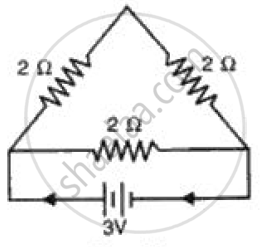
What is the current I in the given circuit (Fig. )?
Define electric power. An electrical device of resistance R is connected across a source of voltage V and draws a current I. Derive an expression for power in terms of current and resistance.
Which cable, one rated 15A and the other rated 5A will be thicker? Give a reason.
What changes in energy occur in an electric bulb?
Two lamps are rated 220V, 50W and the other rated 220V, 100W are connected in series with the mains of 220 V. Explain, why the 50W lamp glows more?
How does the heat produced by die passage of current in a metallic wire depend on the resistance of the wire.
An electric iron is rated at 230 V, 750 W. What is its resistance? What maximum current can be passed through it?
What is the meaning of electric power of an electrical device? Write its SI unit.
