Advertisements
Advertisements
प्रश्न
Define Electric power.
Advertisements
उत्तर
Electric power (P) is the rate at which electrical energy is transferred or consumed in an electrical circuit.
APPEARS IN
संबंधित प्रश्न
Name two safety devices which are connected to the live wire of a household electric circuit
What is the meaning of the symbol kWh? Which quantity does it represent?
Define watt-hour. How many joules are equal to 1 watt-hour?
When an electric lamp is connected to 12 V battery, it draws a current of 0.5 A. The power of the lamp is:
(a) 0.5 W
(b) 6 W
(c) 12 W
(d) 24 W
The SI unit of energy is :
(a) joule
(b) coulomb
(c) watt
(d) ohm-metre
Which of the following is the most likely temperature of the filament of an electric light bulb when it is working on the normal 220 V supply line?
(a) 500°C
(b) 1500°C
(c) 2500°C
(d) 4500°C
Calculate the current through a 60 W lamp rated for 250 V. If the line voltage falls to 200 V, how is the power consumed by the bulb affected?
A current of 0.2 A flows through a wire whose ends are at a potential difference of 15 V.
calculate:
(i) the resistance of the wire and
(ii) the heat energy produced in 1 minute.
Two bulbs are rated 60 W, 220 V and 60 W, 110 V respectively. Calculate the ratio of their
resistances
An electric bulb is rated 250 W, 230 V. Calculate:
- the energy consumed in one hour
- the time in which the bulb will consume 1.0 kWh energy when connected to 230 V mains.
Two resistors A and B of resistance 4 Ω and 6 Ω respectively are connected in parallel. The combination is connected across a 6 volt battery of negligible resistance. Calculate: (i) the power supplied by the battery, (ii) the power dissipated in each resistor.
An electric bulb of resistance 500 Ω draws current 0.4 A from the source. Calculate:
- the power of bulb and
- the potential difference at its end.
Two resistors A and B of 4 Ω and 6 Ω, respectively are connected in parallel. The combination is connected across a 6 volt battery of negligible resistance. Calculate the power dissipated in each resistor.
What is electric power? State and define its S.I. unit.
Why is heating coil wound in the form of a helix in electric stove?
Name two common material used for heating elements.
Two lamps are rated 220V, 50W and the other rated 220V, 100W are connected in series with the mains of 220 V. Explain, why the 50W lamp glows more?
What would happen and why, to an electric bulb when it is connected across a supply of voltage (i) lower (ii) higher than its proper rating?
Three 250 W heaters are connected in parallel to a 100 V supply, Calculate the energy supply in kWh to the three heaters in 5 hour.
With reference to the diagram shown below calculate:

(i) The equivalent resistance between P and Q.
(ii) The reading of ammeter.
(iii) The electrical power between P and Q.
State other bigger units of electric power and express them in watt.
Find the heat produced in joules when a current of 10 amperes flows through a connecting wire of resistance 2 × 10⁻² ohms and heating element of resistance 250 ohms for 2 seconds.
Out of the three fuses with current ratings 5A, 10A, 15A, which one is to be connected in a geyser circuit marked 3 kW, 220V? Give reason for your answer.
A bulb is connected to a battery of e.m.f. 6V and internal resistance 2Ω A steady current of 0.5A flows through the bulb. Calculate the resistance of the bulb.
A battery of e.m.f. 12V and internal resistance 1.6 Ω is connected to two resistors of 4Ω and 6Ω connected in parallel. Calculate:
(i) the current drawn from the battery,
(ii) the power dissipated in each resistor,
(ii)the total power supplied by the battery.
The resistance of filament of an electric heater is 500 Ω It is operated at 200V for 1 hour daily. Calculate the current drawn by the heater and the energy consumed in joule.
1 mV is equal to:
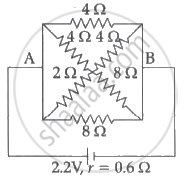
In the given figure, the emf of the cell is 2.2 V, and if internal resistance is 0.6 Ω. Calculate the power dissipated in the whole circuit.