Advertisements
Advertisements
प्रश्न
An electric current is passed through a metallic wire. The wire gets heated up. Give the reason. Is it possible to melt the wire by passing a heavy current?
Advertisements
उत्तर
The metallic wire gets heated up on passing an electric current through it due to collisions of free electrons and energy is transferred to the positive ions which begin to vibrate more violently, causing to produce heat. It is possible to melt the wire by passing a heavy current. The wire will melt when its temperature due to heating reaches its melting point.
संबंधित प्रश्न
State and define the household unit of electricity.
A geyser is rated 1500 W, 250 V. This geyer is connected to 250 V mains. Calculate:
(i) the current drawn
(ii) the energy consumed in 50 hours, and
(iii) the cost of energy consumed at Rs. 4.20 per kWh
A coil of copper wire is connected to a galvanometer. What would happen if a bar magnet is:
(i) Pushed into the coil with its north pole entering first?
(ii) Held at rest inside the coil?
(iii) Pulled out again?
Fig . shows the essent ial features of a battery operated bell. The hammer strikes the gong when the swi tch is closed . State and explain the effect of using the following material successively to form the core.
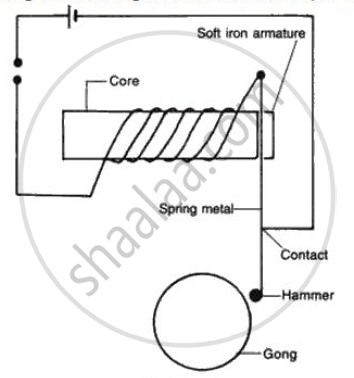
(a) Plastic
(b) Steel
(c) Copper
Point out two main disadvantages of ‘Tree System’.
Name two common material used for heating elements.
If the rating of an electric bulb is 100W – 230V, Explain its meaning.
How does earthing prevent electrical shock?
A. bulb is rated at 100W, 250V and another one at 60W, 250V. What is the current flowing in the circuit if the two bulbs are put in series across a 220 V mains supply?
1 kWh is equal to:
