Advertisements
Advertisements
प्रश्न
Define Electric power.
Advertisements
उत्तर
Electric power (P) is the rate at which electrical energy is transferred or consumed in an electrical circuit.
APPEARS IN
संबंधित प्रश्न
An electric lamp is labelled 12 V, 36 W. This indicates that it should be used with a 12 V supply. What other information does the label provide?
The unit for expressing electric power is:
(a) volt
(b) joule
(c) coulomb
(d) watt
An electric kettle for use on a 230 V supply is rated 3000 W. For safe working, the cable connected to it should be able to carry at least:
(a) 2 A
(b) 5 A
(c) 10 A
(d) 15 A
Name two gases which are filled in filament type electric light bulbs.
Why is an electric light bulb not filled with air? Explain why argon or nitrogen is filled in an electric bulb.
A bulb marked 12 V, 24 W operated on a 12 volt battery for 20 minutes. Calculate:
(i) the current flowing through it, and
(ii) the energy consumed
A geyser is rated 1500 W, 250 V. This geyer is connected to 250 V mains. Calculate:
(i) the current drawn
(ii) the energy consumed in 50 hours, and
(iii) the cost of energy consumed at Rs. 4.20 per kWh
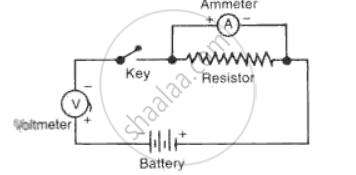
What is wrong with the circuit diagram (Fig. 34)? Carefully check the symbols and assign proper positive and negative signs to them.
The diagram shows a coil connected to a center zero galvanometerG . The galvanometer shows a deflect ion to the right when the north pole N of a powerful magnet is moved to the right as shown .
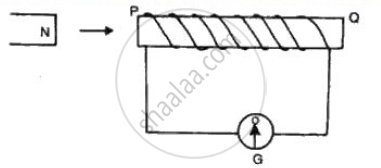
(i) Explain, why the defelct ion occurs in the galvanometer.
(ii ) State whether th e current in the coil is cl ockwise or anticl ockwise
when viewed from the end P.
(iii ) State th e observation in G when the coil is moved away from north
pole N of the magnet keeping the magnet stationary.
(iv)State the observation in G when both the coil and the magnet are
moved to right at th e same speed .
State three factors on which the heat produced in a metallic wire due to passage of current in it depends.
An electric current is passed through a metallic wire. The wire gets heated up. Give the reason. Is it possible to melt the wire by passing a heavy current?
Of the three connecting wires in a household circuit: Which two of the three wires are at the same potential? In which of the three wires should the switch be connected?
What would happen and why, to an electric bulb when it is connected across a supply of voltage (i) lower (ii) higher than its proper rating?
Why is the electric power from the generating station transmitted at high voltage?
Three 250 W heaters are connected in parallel to a 100 V supply, Calculate the resistance of each heater.
An electric kettle is rated 3kW, 250V. What should be the current capacity of the fuse with it?
What is the resistance of an appliance rated at V volt, P watt?
Find the heat produced in joules when a current of 10 amperes flows through a connecting wire of resistance 2 × 10⁻² ohms and heating element of resistance 250 ohms for 2 seconds.
An Electric bulb is marked 100 W, 230 V. What current does it take?
The equation I2R seems to suggest that the rate of heating in a resistor is reduced if resistance decreases, whereas equation P = V2/R suggests just the opposite. How do you reconcile this problem?
A bulb is marked 100W, 220V and an electric heater is marked 2000 W, 220 V.
(i) What is the ratio between the resistances of these two devices?
(ii) How does the power-voltage rating of a device help us to decide about the type of leads (connecting wires) to be used for it?
(iii) In which of the above two devices, a thicker connecting wire of lead is required?
The following table gives the electrical appliances used, their power and the average time for which they are used each day in a home. Estimate the monthly electricity bill if the rate is 60 paise per unit.
| Sr.no. | Name | Nos. | Power rating | Time/day |
| 1 | Bulb | 4 | 100 W | 7.5 hr |
| 2 | Fans | 2 | 50 W | 10 hr |
| 3 | T.V. | 1 | 100 W | 2 hr |
| 4 | Iron | 1 | 500 W | 1 hr |
| 5 | Electric stove | 1 | 750 W | 2 hr |
A torch bulb is rated at 3 V and 600 mA. Calculate it’s
- power
- resistance
- energy consumed if it is used for 4 hours.
Electric power is inversely proportional to ____________.
A family uses 8 kW of power. Direct solar energy is incident on the horizontal surface at an average rate of 200 W per square meter. If 20% of this energy can be converted to useful electrical energy, how large an area is needed to supply 8 kW?
A room has AC run for 5 hours a day at a voltage of 220V. The wiring of the room consists of Cu of 1 mm radius and a length of 10 m. Power consumption per day is 10 commercial units. What fraction of it goes in the joule heating in wires? What would happen if the wiring is made of aluminium of the same dimensions?
`[ρ_(Cu) = 1.7 xx 10_(Ωm)^-8, ρ_(Al) = 2.7 xx 10^-8 Ωm]`
