Advertisements
Advertisements
प्रश्न
What is electric power? State and define its S.I. unit.
Advertisements
उत्तर
Electric power is the rate of doing work or it is the work done in 1 second.
The S. I. unit of power is ‘Watt’.
If a current of 1 ampere flows through a metallic conductor at a potential difference of 1 volt, the power is said to be 1 watt.
or 1 Watt = 1 Volt × 1 Ampere.
संबंधित प्रश्न
An electric kettle for use on a 230 V supply is rated 3000 W. For safe working, the cable connected to it should be able to carry at least:
(a) 2 A
(b) 5 A
(c) 10 A
(d) 15 A
Electrical power p is given by the expression P = (Q × V) ÷ time. Express the power P in terms of current and resistance explaining the meaning of symbols used there in.
A resistor of resistance R is connected to an ideal battery. If the value of R is decreased, the power dissipated in the resistor will ______________ .
Write the SI units for:
(a) Electric current
(b) Potential difference
(c) Charge.
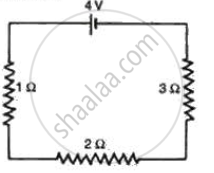
Tick(✓) the correct choice in the following:
In the circuit shown in the following fig, the e.m.f. of the cell is 4 volts, the current
flowing through the resistor is
An electric filament lamp is connected to a supply of voltage higher than the recommended value. Give reasons, why compared with a normal performance, the lamp emits a brighter light and its life is shortened.
What is the function of the split rings in a d.c. motor?
Three 250 W heaters are connected in parallel to a 100 V supply, Calculate the resistance of each heater.
A bulb is connected to a battery of e.m.f. 6V and internal resistance 2Ω A steady current of 0.5A flows through the bulb. Calculate the total energy supplied by the battery in 10 minutes.
Unit of electric power may also be expressed as:
