Advertisements
Online Mock Tests
Chapters
![Lakhmir Singh solutions for Physics [English] Class 10 ICSE chapter 11 - Heat - Shaalaa.com](/images/physics-english-class-10-icse_6:bfbcc704031b4fd398b72f80ee978e3f.jpg "Lakhmir Singh solutions for Physics [English] Class 10 ICSE chapter 11 - Heat")
Advertisements
Solutions for Chapter 11: Heat
Below listed, you can find solutions for Chapter 11 of CISCE Lakhmir Singh for Physics [English] Class 10 ICSE.
Lakhmir Singh solutions for Physics [English] Class 10 ICSE 11 Heat Intex Question [Pages 258 - 274]
THINK AND ANSWER
What will happen if we add ice in a bowl of boiling water?
THINK AND ANSWER
What could be the highest temperature ever created by humans?
THINK AND ANSWER
In our school desk, why steel part feels colder than the wooden part?
THINK AND ANSWER
Why do people in coastal areas do not feel too cold during winter?
TEST YOUR UNDERSTANDING - 1
Define calorie. How many joules make one calorie?
Explain why does ice start melting from the bottom.
State three differences between heat and temperature.
If an object absorbs 1050 J of heat energy, then calculate the calories of heat energy absorbed by the body.
Explain and write the relationship between °C and °F.
Which physical quantity has J/g K unit?
In the Q = cmΔT expression, explain each term and write their units.
State whether the following statement is true or false.
A temperature of 0°C is equal to 273.15 K.
State whether the following statement is true or false.
Temperature is the measure of all the kinetic energy inside the body.
Choose the correct option for each of the following questions.
The factor which is directly proportional to the amount of heat absorbed by any metal is/are:
Area of cross-section
Nature of material
Both area of cross-section and nature of material
None of the above
The value of 70°C in °F scale is ______.
90°F
158°F
−128°F
68°F
Fill in the following blanks with suitable words.
______ is the measure of the average kinetic energy of the body.
______ is the product of mass and specific heat capacity.
Find the specific heat capacity of a 40 g sample of iron whose temperature is increased by 10°C when 2000 J of energy is being supplied.
THINK AND ANSWER
How does an ice cube cool the drink?
TEST YOUR UNDERSTANDING - 2
Explain the impact of pressure on the boiling point.
Explain heat and temperature on the basis of the kinetic theory of matter.
Explain the latent heat of vaporisation.
What do you mean by anomalous behaviour of water?
Which physical quantity has the unit of kJ/kg?
In the expression Q = mL, explain each term and write its Sl unit.
State whether the following statement is true or false.
When we add salt to water, its melting point increases.
State whether the following statement is true or false.
When ice melts at 0°C, its volume increases.
State whether the following statement is true or false.
In the mountains, water boils faster.
Choose the correct option for each of the following questions.
The amount of energy needed to convert a liquid into a gas and vice versa without a temperature change is known as ______.
latent heat of vaporisation
heat capacity
latent heat of fusion
specific heat capacity
The energy released or absorbed during a change of state is known as ______.
thermal heat
latent heat
kinetic energy
potential energy
Fill in the following blanks with suitable words:
______ amount of heat energy required to melt 15 kg of ice when the specific heat of ice is 336 J/g.
An increase in ______ increases the boiling point of water.
Beginning at 20°C, what amount of heat is required to heat 0.3 kg of aluminium to its melting point and then to convert it to liquid? [Specific heat capacity of aluminium = 900 J kg−1 °C−1; specific latent heat of aluminium = 321,000 J kg−1 and melting point of aluminium = 660°C].
If the amount of heat required for a change of phase is 600 kcal. Calculate the latent heat of a 10 kg material.
Lakhmir Singh solutions for Physics [English] Class 10 ICSE 11 Heat EXERCISE [Pages 276 - 279]
Objective Questions
True or False.
A thermometer is the device used to measure the hotness of the body.
True or False.
The thermal energy needed to raise the temperature of a substance is called latent heat.
Water can stay as liquid below 0°C.
True or False.
Water can boil below 100°C.
True or False.
The SI unit of specific heat capacity is J/kg.
Fill in the Blanks
The SI unit of specific latent heat is ______.
Temperature can be measured using a ______.
The energy value of food is measured in ______.
The temperature at which liquid changes into vapour is known as ______.
The ______ coloured clothes will absorb more heat.
Multiple Choice Questions
If a copper rod at 50°C is dropped in a jar containing water at 50°C, the heat will ______.
flow from copper rod to water
flow from water to copper rod
not flow
none of these
Heat brings ______ changes.
chemical
reversible
physical
periodic
The heat capacity of a body depends upon:
change in temperature
mass of body
nature of substance
all of the above
Heat is measured using ______.
calorimeter
hydrometer
thermometer
lactometer
Specific heat capacity of water in J kg−1 K−1 is ______.
1
4.2
100
4200
What is the average body temperature of the human body?
37°F
37°C
37 K
All are correct
Heat from the Sun reaches us by ______.
conduction
radiation
convection
vaporisation
Choose the true statement from the following list.
As the temperature rises, the rate of evaporation decreases.
As the temperature drops, the rate of evaporation increases.
As the temperature rises, the rate of evaporation also increases.
Temperature has no effect on the rate of evaporation.
With the increase in pressure, the boiling point of water will ______.
increase
decrease
first increase, and then decrease
first decrease, and then increase
The process of the gradual disappearance of a naphthalene ball is known as ______.
evaporation
solidification
sublimation
melting
Match the items of Column I with that of Column II and choose the appropriate code.
| Column I | Column II |
| A. J kg−1 K−1 | (i) Latent heat |
| B. kJ kg−1 | (ii) Heat |
| C. kJ | (iii) Specific heat capacity |
| D. J°C−1 | (iv) Heat capacity |
A - (iii), B - (ii), C - (i), D - (iv)
A - (i), B - (iii), C - (ii), D - (iv)
A - (iv), B - (i), C - (ii), D - (iii)
A - (iii), B - (i), C - (ii), D - (iv)
Descriptive Questions Short Answer Questions
Why does a stone lying in the Sun get heated up much more than water left for the same duration of time?
What is heat capacity?
State unit of heat capacity.
Can water boil at above 100°C? If yes, explain how.
What is calorimetry?
What is the principle of the method of mixtures?
What is the other name given to the principle of the mixtures?
Name the law on which the principle of method of mixtures is based. Explain.
What is the main difference between sensible heat and latent heat?
Write an expression for the heat energy liberated by a hot body.
Define temperature.
Write S.I. unit of temperature.
Explain why does the weather become very cold after a hail storm.
What happens to the heat supplied to a substance when the heat supplied causes no change in the temperature of the substance?
Long Answer Questions
Define the following term:
Specific latent heat
Write the SI unit of Specific latent heat.
Define specific heat capacity.
Write the unit of specific heat capacity.
Define heat capacity.
State unit of heat capacity.
Define the term heat.
Name the SI unit of heat.
Explain with the help of a graph, why, at some specific temperatures, even after adding heat, there is no change in the temperature of the substance.
Examine the graph below. Discuss the differences in how water behaves compared to other substances while taking into account how much water changes in volume as its temperature rises from 0°C. What is the name for this behaviour shown by water?
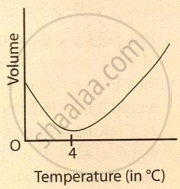
What is the role of the anomalous behaviour of water in preserving aquatic life in regions of cold climate?
Explain the following:
How can you relate the formation of water droplets on the outer surface of a bottle taken out of the refrigerator with the formation of dew?
What is meant by latent heat?
How will the state of matter transform if latent heat is given off?
Which principle is used to measure the specific heat capacity of a substance?
Explain the role of latent heat in the change of state of a substance.
On what basis and how will you determine whether air is saturated with vapour or not?
Water in lakes and ponds do not freeze at once in cold countries. Give a reason is support of your answer.
What is the principle of Calorimetry?
Name the law on which the principle of Calorimetry is based.
State the effect of an increase of impurities on the melting point of ice.
Numerical Problems
A piece of ice of mass 40 g is added to 200 g of water at 50 °C. Calculate the final temperature of water when all the ice has melted. Specific heat capacity of water = 4200 J kg-1K-1, and specific latent heat of fusion of ice = 336 × 103 J kg-1.
100 g of ice at 0°C receives a steady flow of heat energy. At 0°C, the ice melts into the water in 1 minute. How long would it take to bring water from 0°C to 20°C?
[Given: specific heat capacity of water = 4.2 J g−1°C−1 and specific latent heat of ice = 336 J g−1].
A refrigerator takes 30 minutes to transform 100 g of water at 20°C to ice at −10°C. Determine the average heat extraction rate in watts. Specific heat capacity of ice = 2.1 J g−1 °C−1, Specific heat capacity of water = 4.2 J g−1, Specific latent heat of fusion of ice = 336 J g−1.
An 80 g piece of ice is thrown into 140 g of water that is 50°C. Determine the final temperature of water once the ice has fully melted. (Assume there is no heat loss to the environment.) Specific heat capacity of water = 4.2 J g−1 K−1, Specific latent heat of fusion of ice = 336 J g−1.
250 g of water at 30℃ is contained in a copper vessel of mass 50 g. Calculate the mass of ice required to bring down the temperature of the vessel and its contents to 5℃. Given: specific latent heat of fusion of ice = 336 × 103J kg-1, specific heat capacity of copper = 400 J kg-1 K-1, specific heat capacity of water = 4200 J kg-1 K-1.
At 40°C, a chunk of metal has a density of 50 g. When immersed in a steam current at 100°C, 0.4 g of the steam condenses on it. Provided that the latent heat of steam is 640 cal/g, calculate the specific heat of the metal.
Find the mass of ice that is required to lower the temperature of 500 g of water at 50°C to water at 0°C. (Specific latent heat ofice = 336 J/g and specific heat capacity of water = 4.2 J/g°C).
Some heat is given to 120 g of water and its temp. rises by 10 K. When the same amount of heat is given to 60 g of oil, its temp. rises by 40 K. The Sp. heat of water is 4200 J/kgK. Calculate:
(a) The amount of heat in joules given to water,
(b) The specific heat capacity of the oil.
100 g of ice is contained in a thermos flask with a minimal heat capacity. Determine how much steam, at a temperature of 100°C, is required to simply melt the ice. Given that the specific heat capacity of water is 4.2 J g−1 °C−1 and the latent heat of ice is 336 J g−1.
Heat energy is supplied at a constant rate to 100g of ice at 0 °C. The ice is converted into water at 0° C in 2 minutes. How much time will be required to raise the temperature of water from 0 °C to 20 °C? [Given: sp. heat capacity of water = 4.2 J g-1 °C-1, sp. latent heat of ice = 336 J g-1].
The temperature of 170 g of water at 50°C is lowered to 5°C by adding a certain amount of ice to it. Find the mass of ice added.
Given: Specific heat capacity of water = 4200 J kg-1 °C-1 and specific latent heat of ice = 336000 J kg-1.
DO IT RIGHT
Learn more about the three phases of matter. Make a presentation explaining the different processes involved in change of phase. Provide examples of each process. Verify each process in terms of real-life scenarios.
Solutions for 11: Heat
Lakhmir Singh solutions for Physics [English] Class 10 ICSE chapter 11 - Heat
Shaalaa.com has the CISCE Mathematics Physics [English] Class 10 ICSE CISCE solutions in a manner that help students grasp basic concepts better and faster. The detailed, step-by-step solutions will help you understand the concepts better and clarify any confusion. Lakhmir Singh solutions for Mathematics Physics [English] Class 10 ICSE CISCE 11 (Heat) include all questions with answers and detailed explanations. This will clear students' doubts about questions and improve their application skills while preparing for board exams.
Further, we at Shaalaa.com provide such solutions so students can prepare for written exams. Lakhmir Singh textbook solutions can be a core help for self-study and provide excellent self-help guidance for students.
Concepts covered in Physics [English] Class 10 ICSE chapter 11 Heat are .
Using Lakhmir Singh Physics [English] Class 10 ICSE solutions Heat exercise by students is an easy way to prepare for the exams, as they involve solutions arranged chapter-wise and also page-wise. The questions involved in Lakhmir Singh Solutions are essential questions that can be asked in the final exam. Maximum CISCE Physics [English] Class 10 ICSE students prefer Lakhmir Singh Textbook Solutions to score more in exams.
Get the free view of Chapter 11, Heat Physics [English] Class 10 ICSE additional questions for Mathematics Physics [English] Class 10 ICSE CISCE, and you can use Shaalaa.com to keep it handy for your exam preparation.
