Advertisements
Advertisements
Questions
Heat energy is supplied at a constant rate to 100g of ice at 0 °C. The ice is converted into water at 0° C in 2 minutes. How much time will be required to raise the temperature of water from 0 °C to 20 °C? [Given: sp. heat capacity of water = 4.2 J g-1 °C-1, sp. latent heat of ice = 336 J g-1].
100 g of ice at 0°C receives a steady flow of heat energy. At 0°C, the ice melts into the water in 2 minutes. How long will it take to bring the temperature of the water up to 20 degrees? (Specific latent heat of ice = 336 J/g, Specific heat capacity of water = 4.2 J/g °C).
Advertisements
Solution
Heat energy required to melt 100 g of ice at 0 °C is
Q = mL = 100 × 336=33600 J
Therefore, heat energy supplied per minute is
`33600/2=16800 "J min"^-1`
Now, heat energy required to raise the temperature of water from 0°C to 20°C is
Q'=mc × rise in temperature =100 × 4.2 × 20 = 8400 J
If time required for this heat gain is t minutes, then Heat energy supplied in t minutes is
`16800 xx "t"=8400`
`therefore "t" =8400/16800`
`"t" = 0.5 "min"`
`"t" = 30 "s"`
RELATED QUESTIONS
Name the S.I. unit of heat.
What do you mean by the following statement?
The heat capacity of a body is 50 JK-1?
Discuss the role of high specific heat capacity of water with reference to climate in coastal areas.
Name three fossil fuels that emit carbon dioxide into the atmosphere ?
What impact will global warming have on the health of the affected population?
Read the following paragraph and answer the questions.
|
If heat is exchanged between a hot and cold object, the temperature of the cold object goes on increasing due to gain of energy and the temperature of the hot object goes on decreasing due to loss of energy. The change in temperature continues till the temperatures of both the objects attain the same value. In this process, the cold object gains heat energy and the hot object loses heat energy. If the system of both the objects is isolated from the environment by keeping it inside a heat resistant box (meaning that the energy exchange takes place between the two objects only), then no energy can flow from inside the box or come into the box. |
- Heat is transferred from where to where?
- Which principle do we learn about from this process?
- How will you state the principle briefly?
- Which property of the substance is measured using this principle?
104g of water at 30°C is taken in a calorimeter made of copper of mass 42 g. When a certain mass of ice at 0°C is added to it, the final steady temperature of the mixture after the ice has melted, was found to be 10°C. Find the mass of ice added. [Specific heat capacity of water = 4.2 Jg–1°C–1 ; Specific latent heat of fusion of ice = 336 Jg–1; Specific heat capacity of copper = 0.4 Jg–1°C–1] .
A diatomic gas undergoes adiabatic change. Its pressure 'P' and temperature 'T' are related as p ∝ Tx, where x is ______.
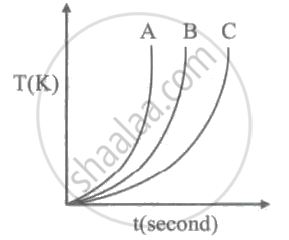
Which of the following substances (A, B and C) has the highest specific beat?