Advertisements
Advertisements
Question
Learn more about the three phases of matter. Make a presentation explaining the different processes involved in change of phase. Provide examples of each process. Verify each process in terms of real-life scenarios.
Very Long Answer
Advertisements
Solution
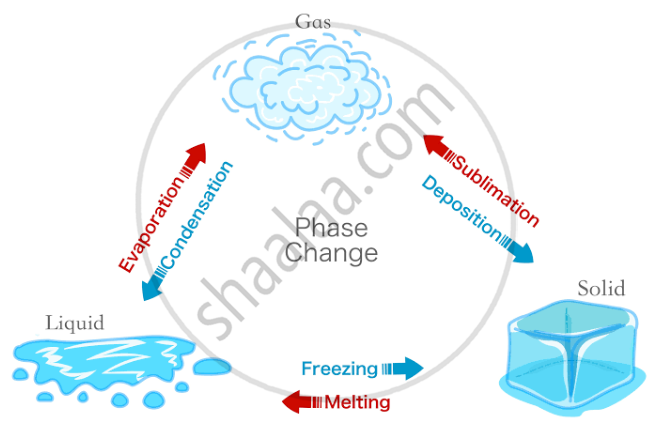
1. The Three Phases of Matter
- Solid: Definite shape and definite volume. Particles are tightly packed together.
- Liquid: Indefinite shape but definite volume. Particles are loosely packed and can flow.
- Gas: Indefinite shape and indefinite volume. Particles are far apart and move rapidly.
2. Processes, Examples, and Real-Life Scenarios
A. Solid ↔ Liquid
- Melting: Solid changes into liquid by absorbing heat.
- Example: Ice turning into water.
- Real-life Scenario: An ice cream melting quickly when taken out of the freezer on a hot summer day.
- Freezing: Liquid changes into solid by releasing heat.
- Example: Water turning into ice cubes.
- Real-life Scenario: Water freezing inside pipelines and blocking them during harsh winters in extremely cold regions like Ladakh.
B. Liquid ↔ Gas
- Vaporisation/Evapouration: Liquid changes into gas (vapour).
- Example: Water boiling to form steam.
- Real-life Scenario: Wet clothes drying out in the sun as water evaporates directly into the air.
- Condensation: Gas or vapour cools down to change into liquid.
- Example: Steam cooling down back into water.
- Real-life Scenario: Tiny water droplets forming on the outer surface of a cold glass because the moisture in the surrounding air cools down upon touching it.
C. Solid ↔ Gas
- Sublimation: Solid changes directly into gas without turning into liquid first.
- Example: Camphor or naphthalene (mothballs).
- Real-life Scenario: Mothballs placed in a clothing wardrobe shrinking and disappearing over time without ever making the clothes wet.
- Deposition: Gas changes directly into solid without turning into liquid first.
- Example: Formation of frost.
- Real-life Scenario: Water vapour in the air turning directly into a thin layer of ice (frost) on grass or car windscreens during freezing winter nights.
shaalaa.com
Is there an error in this question or solution?
