Advertisements
Advertisements
Question
Solve the following question:
In an electric circuit, two resistors of 12 0 each are joined in parallel to a 6 V battery. Find the current drawn from the battery.
Advertisements
Solution
Let net resistance of the given parallel combination be Rnet, Then
`1/"R"_"net"=1/12+1/12`
`1/"R"_"net"= 2/12=1/6`
⇒ Rnet = 6 Ω
Hence, current, `"i"="V"/"R"_"net"=(6"V")/(6 Ω)=1"A"`.
RELATED QUESTIONS
How many 176 Ω resistors (in parallel) are required to carry 5 A on a 220 V line?
A wire that has resistance R is cut into two equal pieces. The two parts are joined in parallel. What is the resistance of the combination?
In the diagram shown alongside, the cell and the ammeter both have negligible resistance. The resistors are identical.
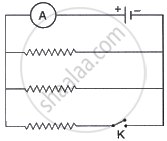
With the switch K open, the ammeter reads 0.6 A. What will be the ammeter reading when the switch is closed?
Which of the following combinations have the same equivalent resistance between X and Y?
You have three resistors of values 2Ω, 3Ω and 5Ω. How will you join them so that the total resistance is less than 1Ω? Draw diagram and find the total resistance.
Calculate the equivalent resistance between the points A and B in Fig. if each resistance is 2·0 Ω.

A cell supplies a current of 1.2 A through two 2Ω resistors connected in parallel. When the resistors are connected in series, if supplies a current of 0.4 A. Calculate the internal resistance and e.m.f of the cell.
State the S.I. unit of electrical resistance and define it.
How does the resistance of a metallic wire depend on the length of wire?
Two resistors of resistances 2 Ω and 3 Ω are connected in parallel to a cell to draw current 0.5 A from the cell. Draw a labelled diagram of the arrangement
