Advertisements
Advertisements
प्रश्न
- What is meant by electric current?
- Name and define its unit.
- Which instrument is used to measure the electric current? How should it be connected in a circuit?
Advertisements
उत्तर
- (i) Electric current is often termed as .current. and it is represented by the symbol .I. It is defined as the rate of flow of charges in a conductor.
(ii) The electric current represents the amount of charges flowing in any cross section of a conductor (say a metal wire) in unit time. - The SI unit of electric vurrent is ampere (A) The current flowing through a conductor is said to be one ampere, when a charge of one coulomb flows across any cross - section of a conductor in one second.
Hence,
1 ampere = `"1 coulomb"/"1 second" ` - (i) Ammeter is used to measure the current.
(ii) An Ammeter is connected in series with circuit.
(iii) The Ammeter is a low impedance device connecting it in parallel with the circuit would cause a short circuit, damaging the Ammeter or the circuit.
APPEARS IN
संबंधित प्रश्न
A p.d. of 6 V is applied to two resistors of 3 Ω and 6 Ω connected in parallel. Calculate:
(a) the combined resistance
(b) the current flowing in the main circuit
(c) the current flowing in the 3 Ω resistor.
Ten bulbs are connected in a series circuit to a power supply line. Ten identical bulbs are connected in a parallel circuit to an identical power supply line.
(b) In which circuit, if one bulbs be brighter?
Find the potential difference required to pass a current of 0.2 A in a wire of resistance 20Ω
What is international convention of colour coding in a cable?
Tick(✓) the correct choice in the following:
A three pin plug is connected to the lead for a 1 kW electric iron to be
used on a 250 V supply. Which of the following statements is not correct?
Find the effective resistance in the following circuit diagrams (Fig.):
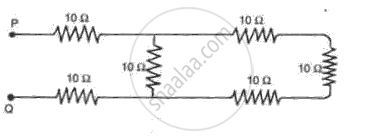
60 joules of heat was dissipated in a resistor when 20 C flowed for 5 s. Calculate:
(a) P.d. across the resistor,
(b) Resistance of the resistor, and
(c) Average power dissipated in the resistor.
A bulb is connected to a battery of p.d. 4 V and internal resistance 2.5 Ω . A steady current of 0.5 A flows through the circuit. Calculate:
The total energy supplied by the battery in 10 minutes
Which of the following represents voltage?
A charge of 400C flows through a conductor for 13 minutes and 20 seconds. Find the magnitude of the current flowing through the conductor.
